
Troubleshooter › Algae
Pool Algaecide
Pool algaecide helps chlorine kill algae and keeps it from coming back, but on its own it will not clear a green pool. Shock first, wait 24 hours, then add algaecide at the dose on its label for your pool size.
- Works in
- 24 to 48 hours
- Add it
- 24 hours after a shock
- With shock
- Never at the same time
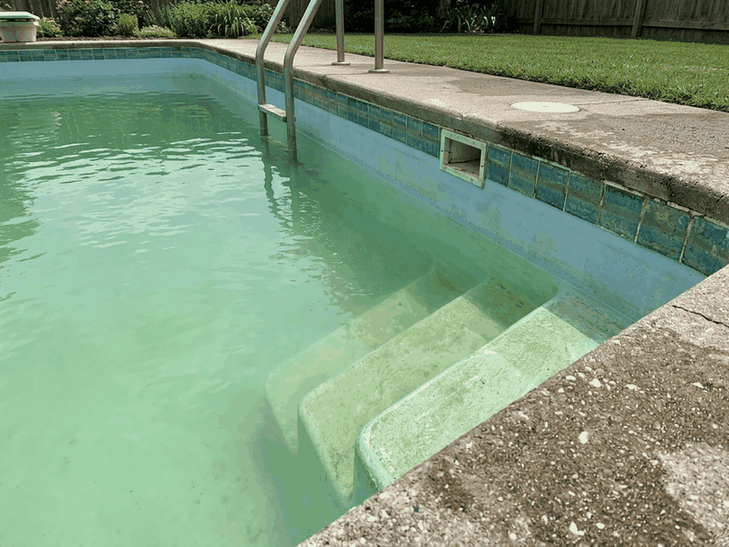
Not sure this is your water? Match your water by photo.
Does Algaecide Work?
Yes, as a helper. Chlorine kills algae much faster than any algaecide, so a green pool still needs shock, brushing and a filter running day and night. Algaecide works best to prevent algae: a weekly or monthly dose stops spores from taking hold, and it is worth adding when you close the pool for winter.
The other good use is finishing a job. After a shock has killed most of a bloom, algaecide helps with the patches chlorine struggles to reach, and it backs up the treatment for mustard and black algae.
How Long Does Algaecide Take to Work?
It starts working as soon as it is in the water, and full results take 24 to 48 hours. When a shock went in first, green water usually turns gray or white within 12 to 24 hours, and the pool is often clear in one to three days, depending on how bad it was.
Keep the filter running the whole time and brush the walls every 8 to 12 hours, so the dead algae reaches the filter.
Pool Algaecide Calculator
Type your pool size for the amount. It uses the dose on one common label, HTH Algae Guard+ Ultra: 2 fl oz per 1,000 gallons for algae you can see, 1 fl oz per 1,000 gallons once a month to keep it away. Other bottles come in other strengths, so use the figure on yours.
How Much Algaecide for a 10,000-Gallon Pool?
On that label, a 10,000-gallon pool takes 20 fl oz for visible algae, or 10 fl oz a month to prevent it.
| Pool size | Algae you can see | Monthly, to prevent it |
|---|---|---|
| 5,000 gallons | 10 fl oz | 5 fl oz |
| 10,000 gallons | 20 fl oz | 10 fl oz |
| 15,000 gallons | 30 fl oz | 15 fl oz |
| 20,000 gallons | 40 fl oz | 20 fl oz |
| 30,000 gallons | 60 fl oz | 30 fl oz |
More is not better. Too much algaecide can make the water foam and cloud.
Quat, Polyquat or Copper: The Three Kinds
- Quat is the cheapest kind, sold as a low-strength liquid. It works, but it can make the water foam if you add too much.
- Polyquat, often sold as "60%", costs more, does not foam and has no metal in it.
- Copper algaecide is strong on stubborn algae, but copper can turn the water green and stain the pool, especially after a shock.
Best Algaecide for a Green Pool
For a green pool, the best product is chlorine shock, and algaecide comes after it. When you do add one, a copper-free polyquat is the safe choice: it will not foam, and it will not add metal that a later shock can turn green or brown. If your fill water is from a well or already holds metal, choose a copper-free algaecide.
Using Algaecide With Shock
- Test free chlorine and pH, and bring pH into the 7.2 to 7.8 range.
- Brush the walls and floor, then shock in the evening at the dose for its color.
- Wait 24 hours. Never pour algaecide and shock in together.
- With the pump running, add the algaecide around the edge of the pool.
- Brush again and keep the filter running until the water is clear.
Some labels say you can swim right after the dose and others ask for a short wait, so check yours. If the water turns cloudy after the algaecide, see cloudy after adding chemicals.
Questions About Pool Algaecide
Can algaecide replace chlorine?
No. It helps chlorine but cannot keep the water safe on its own. Free chlorine still has to stay at 1 to 4 ppm (parts per million).
Is algaecide safe for a salt water pool?
Yes. Choose a copper-free one, since copper can stain and build up on the salt cell, and follow the label for your pool size.
Why is my pool cloudy after algaecide?
Usually the algae it killed is still floating, or too much went in. Run the filter day and night, clean it when the pressure rises, and give it a day or two. If it is foamy as well, the dose was too high.
Get the plan for your pool size
Tap the photo that matches your water and type your pool size: the troubleshooter works out the shock in pounds and the liquid chlorine in gallons.