
Troubleshooter › Algae
Black Algae
Black algae forms small black spots in cracks on pool surfaces, especially plaster. Treatment usually takes one to three weeks and involves repeated brushing, a large dose of chlorine and running the filter continuously for at least 24 hours.
- Brush
- Steel on plaster, nylon on vinyl
- Shock
- 4 lb per 10,000 gallons
- Treatment takes
- 1 to 3 weeks
- Can you swim?
- Wait 8 hours after a shock, then retest
Not sure this is your water? Match your water by photo.
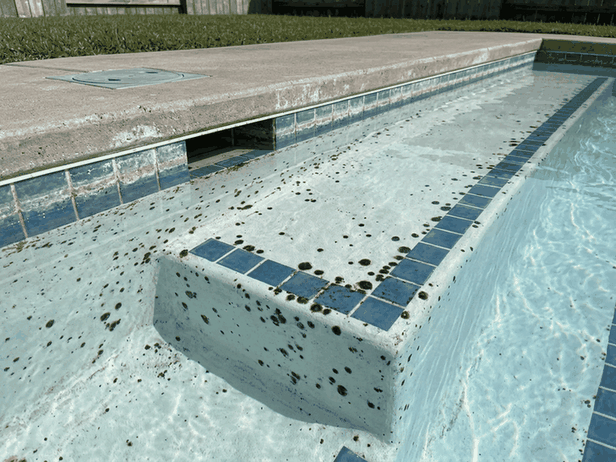
What is black algae?
Those dark specks are not true algae. They belong to a group of bacteria that grows as tiny dark spots and shields itself with a layer that resists chlorine. The pigment inside is the same one plants carry, but extra compounds sit on top of it and hide the green, so the dots look black.
The spots take hold in cracks and rough spots on pool surfaces, plaster especially. Green and yellow algae can appear in a pool on their own, but black algae always arrives from another place. It can hitch a ride on swimsuits, pool toys or scrub brushes after a visit to a lake, pond, river or some other infected pool.
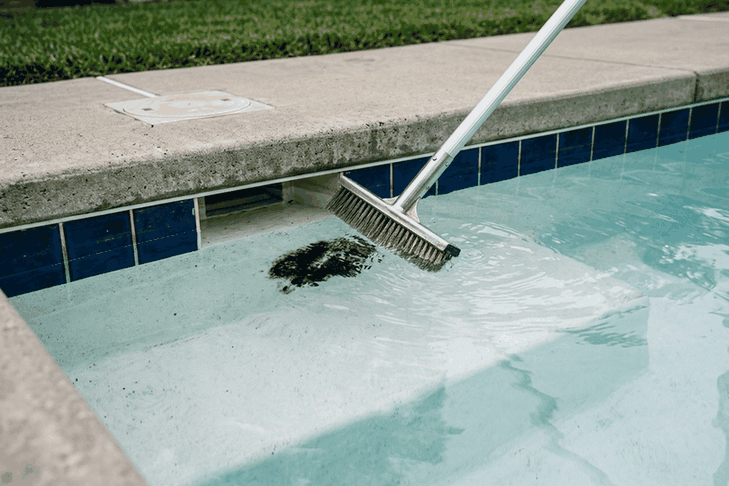
Why is it so hard to kill?
Every cell builds a coating around itself, and that coating leaves black algae partly protected at normal chlorine levels. On its own, chlorine often cannot touch the living cells hiding below.
Brushing cracks that coating open. Once it is open, chlorine or algicide can get inside. An algicide is a chemical designed to kill algae.
How the treatment works
Three things have to work together here: hard brushing, a very high chlorine level and a filter that never stops. The chlorine comes from shock, which is one big dose of chlorine used to knock out algae and haze. The usual powder form goes by the name cal-hypo.
Free chlorine is the chlorine that is still free to sanitize the water, and it is the figure your test kit reports. Ppm is how it is measured, short for parts per million. With black algae you want free chlorine sitting at 10 to 20 ppm, a level far past what is safe for swimming.
On this site, black algae gets 4 lb of shock for every 10,000 gallons, the biggest dose we recommend. Powder can be swapped for liquid chlorine. They do the same job, so pick one and stick with that choice alone.
| Dose for each 10,000 gallons | How much for black algae |
|---|---|
| Cal-hypo powder shock | 4 lb |
| Liquid chlorine at 12.5% strength | about 0.6 gallon for each 1 lb of shock |
| Liquid chlorine at 10% strength | roughly 3 gallons |
The pool-size box on the home page works out the amounts for your own pool.
Shock powder and liquid chlorine are sold in set bag and jug sizes. Get enough to cover the full amount your pool needs, pour only what you measured and keep the rest stored.
Cal-hypo puts calcium into the water. If calcium hardness (how much dissolved calcium the water holds) is already above 400 ppm on your test, go with liquid chlorine instead. Dark finishes call for extra caution, since granular chlorine may bleach out a dark finish, so liquid chlorine is the safer pick there.
While chlorine sits that high, keep pH (how acidic or basic the water is) in the range of 7.2 to 7.8, as the Illinois Department of Public Health recommends. For your safety, never mix pool chemicals, and wear protective gear when handling them. The CDC warns that mixing chemicals or handling them without protective gear can cause injuries.
Most strips max out near 10 ppm and cannot show whether you reached that goal. A drop kit that measures high free chlorine levels, usually sold under the name FAS-DPD, will give you the real number.
How to Get Rid of Black Algae
- Scrub every spot hard until the coating breaks. On vinyl and fiberglass, use a nylon brush instead of a steel one.
- Add the shock, 4 lb for every 10,000 gallons, or about 0.6 gallon of 12.5% liquid chlorine for each 1 lb of shock.
- Check the water to confirm free chlorine lands between 10 and 20 ppm and pH stays between 7.2 and 7.8.
- Keep the filter going for at least 24 hours straight. In a pool with a dark finish, run the pump for a full day after treatment.
- Go back over the spots 3 to 4 times a day. Every pass reopens the coating and lets chlorine reach the cells.
- When the spots disappear, continue treating for 1 more full week.
- Wash the brush once you are done. Disinfect it and give it a hot-water or pressure-washer rinse, then reserve it for pools that have carried black algae.
You will know the treatment worked when the water looks clear and free chlorine falls by no more than 1 ppm overnight. Test once after sunset and once more before sunrise. A larger drop tells you something in the pool is still burning through chlorine.
Swimming Again After Treatment
Wait to swim until you can see the main drain, the grate at the pool's deepest point, from the poolside. Free chlorine should sit between 1 and 4 ppm (or no lower than 2 ppm if the pool uses stabilizer), with pH kept in the range of 7.2 to 7.8. Those limits are set out by the CDC and the Model Aquatic Health Code.
Stopping Black Algae From Returning
Brushing 1 to 2 times a week helps keep black algae from coming back. It also pays to shock on a schedule and add a preventative algicide, beginning with one dose and following up each week.
Keeping black algae out matters just as much, because it cannot appear on its own. Wash swimsuits worn in lakes, ponds or rivers before they enter the pool. Consistent care and healthy chlorine levels do their part too, while too much stabilizer (cyanuric acid, which shields chlorine from sunlight) holds the chlorine back.
Questions People Ask About Black Algae
Can shock alone clear black algae?
No. Shock has to be paired with hard brushing and a filter that keeps running, because the coating shields the cells. Also expect your test to read lower than the dose suggests, since algae and debris use up chlorine right away. If free chlorine slips under 10 ppm during treatment, add more to bring it back up.
What is the best way to clean pool toys?
Choose a chlorine-based disinfectant rather than an ammonia-based one. Anything that has floated in a lake or river deserves a wash before it goes back in the pool.
Why did the water turn clear green after the shock?
Water that turns clear green right after shocking usually points to metal in the water, copper or iron for example, not to algae. Adding more shock only makes it worse.
Not quite your water?
Tap the photo that matches your water for the likely cause and the plan that goes with it.