
Troubleshooter › Cloudy water
Cloudy Pool After Opening
When a pool turns cloudy right after opening, the water usually has barely any chlorine left in it, along with a winter's worth of fine dirt and debris. Start by testing the water, since what the test says tells you whether the pool needs a shock or just a cleaner filter and more hours of pumping.
- Likely cause
- Low chlorine and winter debris
- First step
- Clean the filter, then shock
- Usually clears in
- A few days, up to a week
- Can you swim?
- Not until you can see the main drain. That is the grate at the deepest point, and free chlorine should read 1 to 4 ppm (parts per million).
Not sure this is your water? Match your water by photo.
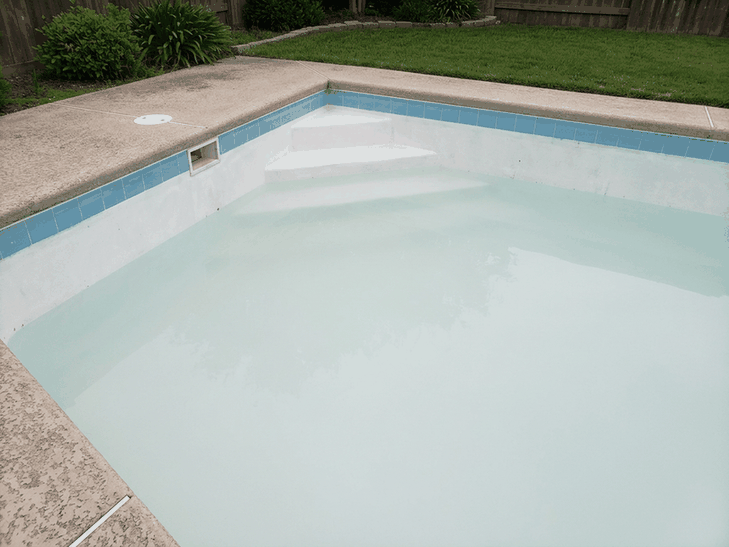
Why Does a Pool Go Cloudy at Opening?
All winter long the chlorine fades away, and eventually there is nothing left to keep the water clean. On the test, the number that matters is free chlorine, meaning the chlorine that can still do its job. The CDC says a pool needs at least 1 ppm of free chlorine, and at least 2 ppm when the pool uses stabilizer. Ppm stands for parts per million, the unit your test strip or kit prints.
Stabilizer protects chlorine from the sun. Without it, sunlight destroys the chlorine before the chlorine gets a chance to work.
If free chlorine looks good on the test, then the cloudiness likely started inside the water itself. Water heavy with calcium, or loaded with dissolved solids, will both give water a milky look. Total alkalinity, which holds the pH steady, belongs somewhere in the 80 to 120 ppm range, and pH belongs between 7.2 and 7.8 so the chlorine can do its job.
Give the Filter a Deep Clean on Opening Day
A filter left idle since autumn cannot grab fine particles very well, so opening day is the right moment for a thorough scrub-down. Plan on this kind of deep clean 2 to 3 times a season, and count opening day as one of them.
The filter's pressure gauge tells you when it needs cleaning again. If the gauge sits 8 to 10 psi higher than its clean reading, backwash a sand or DE (diatomaceous earth) filter by running it in reverse to flush the dirt out, or hose off a cartridge filter, the pleated tube kind. By the clean reading we mean the number the gauge gave as soon as the filter had been cleaned.
While the water is still cloudy, keep the pump running 24 hours a day so all the water keeps passing through the filter over and over. After the water clears, the pump still has to run at least 8 hours each day to hold that clarity.
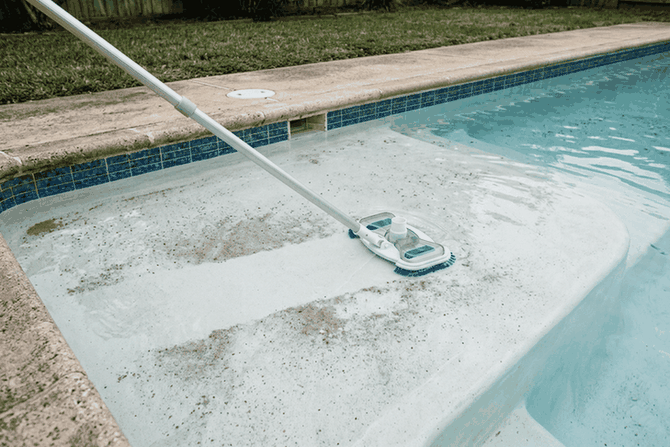
A Shock for Cloudy Water That Is Low on Chlorine
A shock means one big dose of chlorine that wipes out algae and haze at once. The powder most people reach for is cal-hypo, the everyday name for calcium hypochlorite, typically sold at 65% strength. A cloudy pool that tests under 1 ppm free chlorine needs a chlorine-based shock, roughly a pound of cal-hypo for every 10,000 gallons of water.
Liquid chlorine can do the same job. In a 10,000-gallon pool, roughly 0.6 gallon of 12.5% liquid chlorine, about 80 fl oz, stands in for that 1 lb dose, and if your jug is 10%, pour about a quarter more. You use one or the other, never both, since the CDC cautions that mixing pool chemicals can hurt people. On top of that, cal-hypo adds calcium, so if the pool's calcium hardness is already above 400 ppm, liquid chlorine is the better pick.
There is no stabilizer in cal-hypo, so pour it in at night when the sun cannot eat it up. Water that gets cloudier during a shock is normal, and it settles as the filter pulls out everything the chlorine killed.
When the Pool Goes Green After Opening
Water that has turned green tells you algae spent the winter growing under the cover, and algae needs a stronger shock than haze does. How green the water is decides how much you use. All the amounts below are for 10,000 gallons; the pool-size box on the home page works out the amount for your pool.
| Shade of green | Cal-hypo dose |
|---|---|
| Pale green or teal | 2 lb |
| Deep green | 3 lb |
| Green-black or true black algae | 4 lb |
Clear water with slightly low free chlorine needs a liquid chlorine top-up, not a shock.
A dose gives you a predictable rise in free chlorine, not a promised reading. A single pound of 65% cal-hypo lifts a 10,000-gallon pool by nearly 8 ppm, though algae and debris burn through chlorine immediately, so your test will show less than that.
If the water is clear but has a green tint right after a shock, that is a separate problem. That tint usually points to copper or iron dissolved in the water rather than algae, and more shock will only deepen the problem.
Why Do Pools Go Green Over Winter?
Algae will show up any time chlorine is gone and the water sits still, and a covered pool spends months exactly like that. By the time spring arrives, free chlorine is often down to zero, which is why the plan starts with the first test you run once the cover is off.
Most test strips top out around 10 ppm, which falls short of what it takes to clear algae. For that job you want a FAS-DPD kit, a drop test that measures free chlorine even at high levels, which gives you the real number while the treatment runs.
How to Clear a Green Pool After Winter
- Start with a water test, because the free chlorine and pH readings set the dose and tell you if chlorine will even work.
- Give the filter a clean, because a big load of dead algae is headed its way.
- Adjust pH to sit between 7.2 and 7.8, so none of the chlorine goes to waste.
- Add the shock dose for your water color once it is dark out.
- Hold free chlorine near 12 ppm until the water is clear, checking it often and adding more whenever the level slips.
- Run the pump nonstop, and clean the filter every time the gauge climbs 8 to 10 psi past its clean reading.
- Once the green gives way to haze, vacuum the dead algae up off the bottom of the pool.
Give the shock 12 to 24 hours to finish off the algae, and after that the filter needs 24 hours to a week to collect what is left. Expect to clean the filter often during this stretch, since it fills up faster now than at any other point in the year.
The treatment is over when free chlorine loses no more than 1 ppm overnight and the water is clear. Test after sunset and again before sunrise. If free chlorine falls by more than 1 ppm overnight, something in the water is still using it up, so keep the level up and keep filtering.
Clarifier and Flocculant for the Last Haze
If the water is cloudy but the green is gone, the algae is dead. From there, vacuum the pool, keep the filter going, and think about a clarifier. A clarifier bunches tiny particles together so the filter can grab them, and once it is in, run the pump on high, without a break, until the water is clear. Wait at least 24 hours before backwashing, since the clumps need that time to form.
Flocculant works the other way, pushing the cloud down to the floor. Let it settle for 8 to 12 hours, overnight usually does it, then vacuum up the settled layer straight to waste rather than through the filter. Sending water to waste means setting the filter valve to "waste," which sends the dirty water out of the pool for good instead of packing the filter.
Swimming Again After Opening
No one gets back in the water until you can spot the main drain, the grate down at the deepest point, from the pool's edge. Free chlorine should show 1 to 4 ppm on the test, no less than 2 ppm where stabilizer is in use, and pH should stay inside 7.2 and 7.8.
The CDC's Model Aquatic Health Code also says a public pool must not open if the main drain cannot be seen from poolside.
Common Questions
Does shock fix a cloudy pool?
Only when low free chlorine or algae is behind the cloudiness. Haze caused by high calcium hardness, too many dissolved solids or a filter that needs cleaning will not respond to extra chlorine, one more reason to test before shocking.
My pool is cloudy but the chemicals are fine, so what now?
Look at the filter pressure and the daily pump hours first, because good chemistry cannot fix water that is not getting filtered. If the gauge has barely moved from its clean reading and the pump is on all day, then a clarifier or flocculant can pull out particles too small for the filter to catch by itself.
Do above ground pools need different treatment when they turn cloudy after opening?
No, the testing, the dosing per 10,000 gallons and the pump schedule all match. If yours has a cartridge filter, plan on hosing it off often during the treatment.
Not quite your water?
Tap the photo that matches your water for the likely cause and the plan that goes with it.