
Pool Water Color Chart
This pool water color chart tells you what each color probably means, which test proves it, and what to do first. Treat color as your first clue, not your answer. Cloudy green usually means algae. Clear green or brown usually means metal dissolved in the water. Milky white usually points to water balance or the filter. Purple means copper is reacting with stabilizer. Each row names the likeliest culprit first, then the confirming test, then the first move to make.
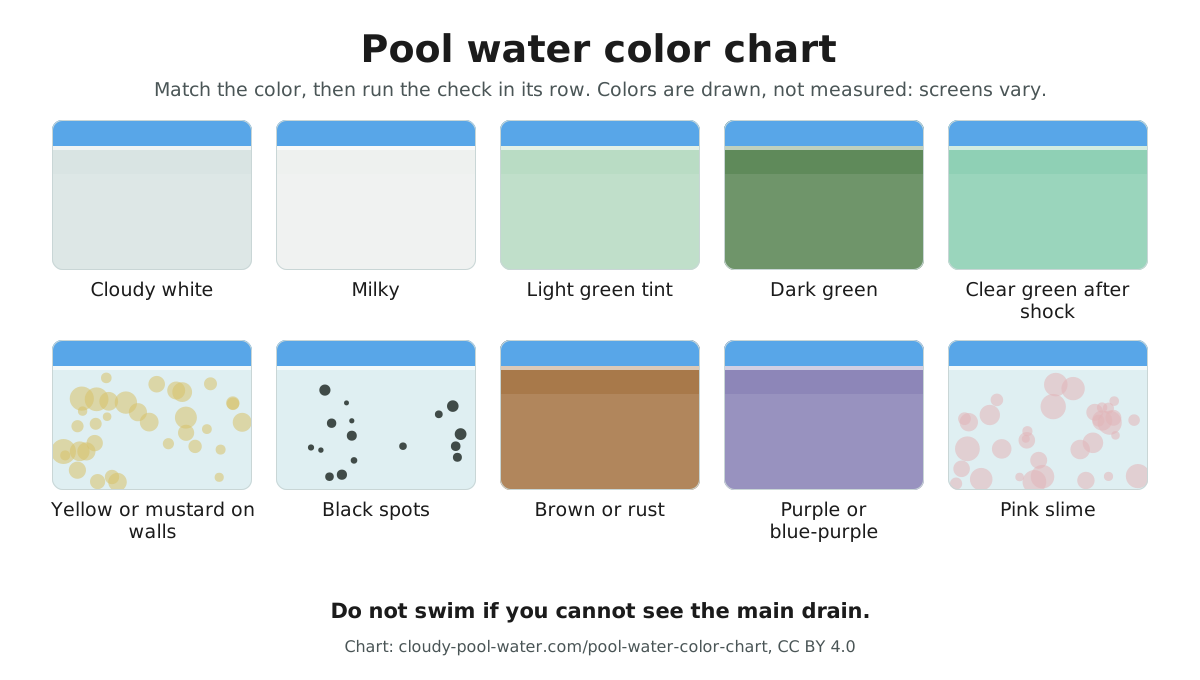
| Color | What you see | Possible causes, most likely first | Next check | First fix |
|---|---|---|---|---|
| Cloudy white | Hazy water, the floor blurred | A filter not keeping up, low chlorine, high pH | Free chlorine and pH; filter pressure and run hours | Balance pH, shock if chlorine is low, filter around the clock |
| Milky | Opaque white, like skim milk | Calcium coming out of the water, dead algae | pH and calcium hardness | Bring pH down, then filter and add clarifier |
| Light green tint | Green tinge, the floor still visible | Early algae | Free chlorine; brush the walls | Brush and double shock |
| Dark green | Opaque green, no floor in sight | Heavy algae | Free chlorine | Brush, triple or quadruple shock, filter nonstop |
| Clear green after shock | Clear water with a green tint | Dissolved copper or other metals | Metal test, or a vitamin C tablet on a stain | Stop shocking, add a metal sequestrant |
| Yellow or mustard on walls | Yellow-brown dust in shady spots | Mustard algae, or pollen if it floats | Brush test: algae clouds up and comes back | Brush, triple shock, wash pool gear |
| Black spots | Raised dark spots on plaster or grout | Black algae, or a metal stain | Scrub test; a vitamin C tablet on the spot | Steel brush on plaster, quadruple shock |
| Brown or rust | Tea-brown water, often right after a shock | Iron, often from well water; dirt after a storm | Metal test of pool and fill water | Stop shocking, add a metal sequestrant, filter |
| Purple or blue-purple | A violet tint, sometimes after a shock | Often copper reacting with other chemicals | Copper test | Add a metal sequestrant, filter |
| Pink slime | Pink film in corners, on ladders or lights | Bacteria, not algae | Look behind ladders, lights and skimmer | Scrub, shock and clean everything the film touched |
What Pool Water Colors Mean by Cause?
Almost every color comes from one of three sources: something alive, something dissolved in the water, or a balance problem. Growing things look like cloudy green, a yellow dust, or black spots. Metal in solution gives clear tints: green water points to copper, and brown or rust points to iron, as this article on green water that is not algae explains. Balance problems make the water look flat, dull blue or milky white.
When water looks flat and dull blue, the usual reasons are free chlorine slipping low, pH creeping high, or a filter that needs a cleaning, per this guide to pool colors. Free chlorine is the chlorine left over, the part that can still do the cleaning. Your test reports it as a number in ppm, the unit printed on your strips or kit. Pink slime gets mistaken for algae, but it is bacteria that travels through the air, not a plant, so it calls for scrubbing every surface it touched.
Green Water: Algae or Metal?
If green water is cloudy, algae grew while the sanitizer ran low. The fix is a shock, meaning a big dose of chlorine that kills algae and haze, along with brushing and running the filter nonstop. Water with algae normally clears about 1 day after shocking.
If green water stays clear, copper is the likely culprit, and it will turn visibly darker once you shock. Adding chlorine only makes that worse, so you use a metal sequestrant instead, a liquid that binds dissolved metal so it cannot leave stains. Order matters here: sequestrant first, shock second, since shocking hard first locks metals into stains. Where does the copper come from? The well water that filled the pool, equipment or heater parts corroding, or algaecides made with copper.
Yellow Water and Mustard Algae
Mustard algae looks like a yellow or yellow-brown dust clinging to the walls, and it favors shade. Brush it: if the water clouds up and the dust comes back, that is your confirmation. To treat it, brush hard, shock heavily and stay patient, because giving up too soon is why it usually comes back.
What Makes Pool Water Black or Spotted?
Dark spots that refuse to budge under a brush are black algae, which sends roots down into plaster pores. You need the heaviest shock there is, 4 lb of cal-hypo for every 10,000 gallons, and you have to scrub hard to open up the surface so the chlorine can get inside.
If the water itself or the plaster turns black or gray, manganese may be the cause instead. That is a dissolved metal, and Pool and Spa News lists manganese as a source of black or gray coloring. Metals want a sequestrant, not extra chlorine.
Purple Stains and Copper
Purple stains show up when copper combines with high stabilizer into a compound called copper cyanurate. Stabilizer, also known as cyanuric acid, protects chlorine from sun. The reaction can begin once stabilizer climbs to 100 ppm or higher with copper floating free instead of being held by a metal control product.
Start with the stabilizer and get it down to 40–50 ppm. A partial drain and refill is the only way to lower it, sometimes repeated several times. Once stabilizer is down, treat the copper with a metal control product, then balance pH and total alkalinity. Purple stains get harder to remove the longer they sit.
Brown, Rusty and Milky White Water
Water that turns brown or tea-colored has oxidized metals like iron or copper in it. When water turns rust-brown right after a fill or top-off, the source water brought iron with it, and the answer is sequestrant, filtering and patience, not shock.
Milky white water traces to high pH, high calcium, or a filter that lets fine bits pass. While you chlorinate, the Illinois Department of Public Health recommends keeping pH between 7.2 and 7.8.
How Much Shock for Each Color?
These figures are for cal-hypo, the usual powdered shock, per 10,000 gallons, and your pool-size box does the math. Shock only when cloudy water reads free chlorine below 1 ppm, or when water is green, never for clear water that merely tests low.
| Water | Cal-hypo (dry) | Liquid chlorine 12.5% |
|---|---|---|
| Cloudy, chlorine low | 1 lb | 0.6 gallon (80 fl oz) |
| Teal or light green | 2 lb | 2 times the 1 lb amount |
| Deep green | 3 lb | 3 times the 1 lb amount |
| Black-green or black algae | 4 lb | 4 times the 1 lb amount |
Pick one column or the other, never both, because the CDC cautions that mixing pool chemicals can hurt people. Cal-hypo raises calcium, so if calcium hardness already tests over 400 ppm, go with liquid chlorine. A 10% jug calls for roughly a quarter extra on top of these amounts.
Your test will read lower than the dose implies, because algae and debris consume chlorine at the same time. Most strips max out near 10 ppm, so during treatment the right tool is a FAS-DPD kit, the drop kind that can measure free chlorine at high levels. You are finished when free chlorine falls by 1 ppm or less overnight, test after sunset and again at daybreak, and the water looks clear.
Swimming Again After the Color Clears
Hold off on swimming until the main drain, the grate sitting at the deepest point, is visible from poolside. The Model Aquatic Health Code applies that same test to public pools. The CDC calls for free chlorine of 1 to 4 ppm, at least 2 ppm when the water uses stabilizer, plus pH between 7.2 and 7.8.
Do not swim if you cannot see the main drain.
cloudy-pool-water.com/pool-water-color-chart/ · Chart: cloudy-pool-water.com, CC BY 4.0