
Troubleshooter › Cloudy water
Cloudy Pool After Rain
When your pool goes cloudy after it rains, the storm has usually thinned out the chlorine and carried in dirt, pollen and other debris. In most cases the water looks normal again within one to three days, provided you clear out the debris, test and balance the water, and give the filter enough time to do its work.
- Likely cause
- Diluted chlorine, dirt and pollen
- Shock
- 1 lb per 10,000 gallons
- Usually clears in
- 1 to 3 days of filtering
- Can you swim?
- Not until you can see the main drain. That is the grate at the deepest point, and free chlorine should read 1 to 4 ppm (parts per million).
Not sure this is your water? Match your water by photo.
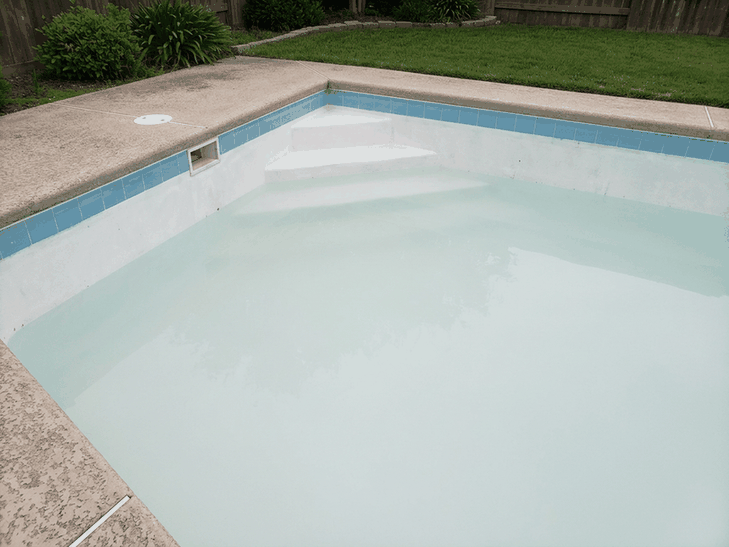
First Steps
Do things in this order. If you clean first, the chlorine has less to fight through, and if you balance the water before treating it, the chlorine does a better job.
- Start by removing leaves and other visible debris, then empty the skimmer basket and clean the filter. A filter that is clean grabs fine dirt instead of plugging up with it.
- Once the rain stops, test three things: free chlorine (the part of the chlorine still working), pH (how acidic or basic the water is) and total alkalinity (what keeps the pH steady). pH belongs somewhere in the range of 7.2 to 7.8. Total alkalinity usually runs around 80 to 120 ppm (parts per million, as your test kit reads it).
- Bring the free chlorine back up. If the water is still cloudy and free chlorine is under 1 ppm, shock the pool (give it one big dose of chlorine that clears algae and haze). In a salt pool, you can turn up the salt chlorine generator instead.
- Let the filter run. Clearing the water typically takes 24 to 72 hours.
- If haze lingers once you have balanced and filtered, a clarifier can help the filter grab those tiny bits.
Whether you top up or shock depends on what the water looks like. Cloudy water with free chlorine under 1 ppm calls for a shock. If the water is clear and free chlorine is only a little low, there's no need to shock. A top-up of liquid chlorine will do, and the pool-size box on the home page works out how much your pool needs.
Why Does Rain Cloud the Water?
Rain thins out chlorine and carries in contaminants that invite algae. One heavy, dirty storm can use up most or all of the chlorine in a pool.
Check pH too. A high pH leaves the water cloudy, weakens chlorine and builds scale, which is why a pool can stay hazy even when there is plenty of chlorine in it.
Sometimes the tests look fine and the water is still hazy. That usually comes down to weak circulation, a dirty or clogged filter, or pollen and dust.
How Much Shock per 10,000 Gallons?
The amounts below are for cal-hypo (calcium hypochlorite), the standard powdered shock, which most often comes at 65% strength. Each dose is per 10,000 gallons of water in the pool.
| Condition of the water | Cal-hypo dose | Or 12.5% liquid chlorine |
|---|---|---|
| Cloudy water with free chlorine under 1 ppm | 1 lb | About 0.6 gallon (80 fl oz) |
| Light green or teal water | 2 lb | Twice the 1 lb amount |
| A darker green | 3 lb | Three times the 1 lb amount |
| Black-green water or black algae | 4 lb | Four times the 1 lb amount |
The pool-size box on the home page works these out for your own pool.
The doses in this table are taken from this guide to shocking. A jug of 10% liquid chlorine needs roughly a quarter more than the table shows. Choose cal-hypo or choose the liquid chlorine, but do not use both. Cal-hypo puts calcium into the water. If your calcium hardness (how much dissolved calcium the water holds) is already above 400 ppm, go with liquid chlorine.
The CDC warns that mixing pool chemicals or handling them without protective gear can cause injuries. Never mix pool chemicals, and never add shock and clarifier at the same time.
When the Water Turns Green
Cloudy green water usually means algae: the rain used up the chlorine, and the dirt it washed in fed the algae. If the water turns clear but green right after you shock, that's usually copper or iron rather than algae, and more shock will only make it worse. Green water needs more shock than cloudy water, and the darker the green, the bigger the dose.
A shock normally takes 12 to 24 hours to finish off algae. On paper a shock lifts free chlorine by a fixed amount, but your test will show a lower number because algae and debris consume chlorine right away. Most test strips max out around 10 ppm. During algae treatment, use a FAS-DPD test kit, a drop test that can measure free chlorine above the range of most strips.
Clearing Algae
Skim, brush and vacuum before you shock. Getting the loose algae and dirt out first means the chlorine isn't used up on mess you could have removed by hand. After cleaning, balance the water and shock, using the amount in the shock table that matches your water's color.
Once the algae dies, the water often turns cloudy. That haze is dead algae; the remedy is vacuuming, running the filter and possibly adding a clarifier.
The treatment is finished once the water looks clear and the overnight free chlorine drop is 1 ppm or less. Test once after sunset and once before sunrise. A bigger overnight drop tells you something in the water is still eating chlorine.
Very Cloudy Water and Heavy Debris
If the water is very cloudy or full of debris, use a flocculant rather than waiting for the filter. It is a liquid that settles the cloud to the bottom so you can vacuum it out. Set the filter valve to waste, then vacuum slowly. With the valve on waste, the dirty water leaves the pool rather than returning through the filter.
Swimming After a Storm
Wait to swim until you can spot the main drain, which is the grate sitting at the pool's deepest point, from the deck. Free chlorine should sit at 1 to 4 ppm, and at least 2 ppm if your pool uses stabilizer (cyanuric acid, which shields chlorine from sunlight). pH belongs between 7.2 and 7.8. These numbers line up with what the CDC suggests for residential pools and with the Model Aquatic Health Code; that code bars a public pool from opening if the main drain cannot be seen from poolside.
Preparing Before the Next Storm
A shock before a storm loads the water with extra chlorine that the rain can use up. Cutting back trees around the pool keeps leaves and branches from landing in the water.
Common Questions
How long should we wait to swim after shocking?
Wait a minimum of 8 hours after you shock, then retest at the 24 hour mark. Even then, the water still needs safe free chlorine and pH readings, and the main drain must be visible.
Is it safe to add clarifier and shock together?
No. The two should not be combined or dosed into the pool together. Once you have added clarifier, wait 24 hours or more before you backwash (run the filter in reverse to flush it) or clean the filter, so the particles it has trapped stay put.
Does heavy rain call for a shock every time?
Shocking after any heavy rain is common advice. Test the water first, though. If the water is clear and free chlorine is only a little low, top up with liquid chlorine rather than shock; the pool-size box on the home page works out the amount.
Not quite your water?
Tap the photo that matches your water for the likely cause and the plan that goes with it.