
Troubleshooter › Cloudy water
Clarifier vs Flocculant
In the clarifier vs flocculant choice, the real difference is speed. Clarifier takes its time, working a light haze out through the filter. Flocculant handles heavy cloudiness fast, dropping the mess to the floor so you can vacuum it out.
- Clarifier
- Filter catches it in 12 to 48 hours
- Flocculant
- Settles in 8 to 24 hours, vacuum to waste
- Cartridge filter?
- Clarifier, not floc
- Can you swim?
- Not until you can see the main drain. That is the grate at the deepest point, and free chlorine should read 1 to 4 ppm (parts per million).
Not sure this is your water? Match your water by photo.
A Quick Look at Both Products
| Clarifier | Flocculant | |
|---|---|---|
| Best for | Slight or medium haze | Very cloudy water |
| Where the dirt ends up | In the filter | On the pool floor |
| Pump | Running all of day one | Brief burst, then off |
| Time to work | Between 12 and 48 hours | Between 8 and 24 hours to sink |
| Extra work | Rinse the filter | Vacuum, then rinse the filter |
| Filter types | Sand, cartridge, or D.E. | Sand; for cartridge or D.E., use clarifier |
Matching the Product to Your Filter
If your filter is D.E. or cartridge, clarifier is your best bet. Either product works with sand, so choose based on how murky the water looks and how soon you want it clear.
Flocculant asks one more thing of you. Your pool has to let you vacuum to waste. That means the dirty water you suck up exits via a waste hose rather than circling back through the filter.
How to Use Pool Clarifier
Clarifier pulls together the fine bits that haze the water and grows them into clumps big enough to filter while they float. Your filter traps the clumps, and you rinse them out later.
- First, check that your chlorine isn't low. Low chlorine can mean the real problem is algae, and clarifier won't fix that.
- Add the amount the bottle lists for your pool size, since brands differ. Do not mix clarifier with shock or add them at the same time.
- Keep the pump running day and night on day one so every bit of water gets pulled through the filter.
- Keep an eye on the filter pressure gauge. When pressure climbs, clean or backwash the filter. Backwashing means sending water backwards through a sand filter to flush out the trapped dirt.
- Now wait. Most pools look better inside 12 to 48 hours.
How to Use Pool Flocculant
Flocculant binds the particles into heavy clumps that drop to the floor, where your vacuum picks them up. You get clear water in hours instead of days, but you'll do more of the work yourself: the pump goes off, and the mess has to be vacuumed out.
- Pour in the amount of flocculant the bottle lists for your pool size and run the pump briefly so it spreads around.
- Switch the pump off. The water needs to sit still so the clumps can drop.
- Give the pool 8 to 24 hours undisturbed while the debris settles.
- Once the debris has fully settled, usually the next day, vacuum it to waste, then clean the filter.
Vacuuming to Waste
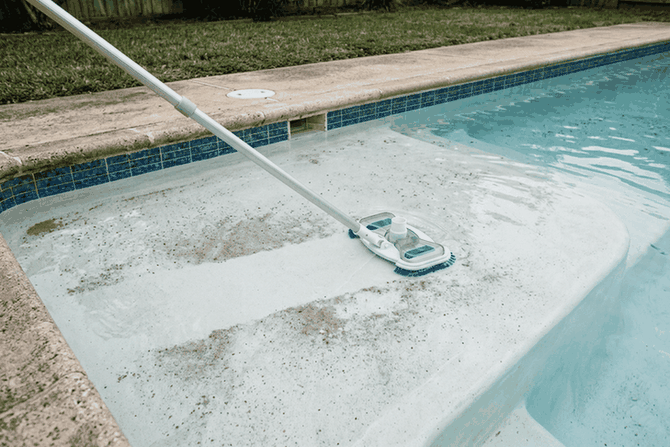
Vacuuming to waste sends water out of the pool, so the level drops as you go. Fill the pool up before you start and leave a hose running while you work.
- Switch the pump off before you touch the valve.
- Set the multiport valve, which controls where the water flows, to Drain or Waste.
- Start the pump again and vacuum up the settled debris.
- When the skimmer starts pulling air, stop, then let the pool fill back up before you continue.
Never let the water fall below the skimmer opening, or the pump could be damaged. Direct the waste water toward a storm drain or a spot that will not erode or get soaked.
Pool Still Cloudy After Clarifier?
When things still look hazy after 48 hours, check the filter first. If the pressure has risen, clean or backwash it.
Low sanitizer can also point to algae as the real trouble. Sanitizer is the chlorine that keeps water clean. The CDC recommends keeping at least 1 ppm (part per million) of free chlorine. If the water is cloudy and chlorine is low, a common shock dose is one pound of powdered pool shock (cal-hypo) for every 10,000 gallons. Roughly 0.6 gallon of 12.5% liquid chlorine gets the same result. Keep pH in the 7.2 to 7.8 range during chlorination.
Questions People Ask
Is too much clarifier harmful?
Yes. An overdose can gum up the filter and leave the water cloudier than it was. Pouring more into a pool that is still hazy can deepen the problem.
Is there a substitute for flocculant?
Clarifier is your other option. It works more slowly, but you do not have to stop the pump or vacuum the pool to waste. Cartridge and D.E. filter owners should stick with it too.
What does "clear enough to swim" mean?
The CDC's model code for public pools says the water has to be clear enough to see the bottom, and a pool shouldn't open if the main drain can't be seen from the side. It's a good yardstick for a backyard pool too.
Get the plan for your pool size
Tap the photo that matches your water and type your pool size: the troubleshooter works out the shock in pounds and the liquid chlorine in gallons.