
Troubleshooter › Other colors
Pool Water Smells
When your pool water smells strongly of chlorine, the cause is usually chloramines, not too much chlorine in the water. A musty smell, on the other hand, usually means algae is just getting started. Both problems go away when you add more chlorine, not less. A pool that is cared for properly has no smell at all.
- Strong chlorine smell
- Chloramines: chlorine used up
- Musty smell
- Usually algae
- Fix
- Shock and run the filter
- Can you swim?
- Wait 8 hours after a shock, then retest
Not sure this is your water? Match your water by photo.
When the Water Smells of Chlorine
Chloramines form when chlorine reacts with the sweat, cosmetics and urine that swimmers bring into the water. That sharp odor people blame on "too much chlorine" is really these compounds. The two to know about are dichloramine and trichloramine.
What clears it is to shock the pool rather than reduce the chlorine. A shock is one big dose of chlorine all at once, enough to remove the chloramines. Check your chemical levels before adding anything fresh.
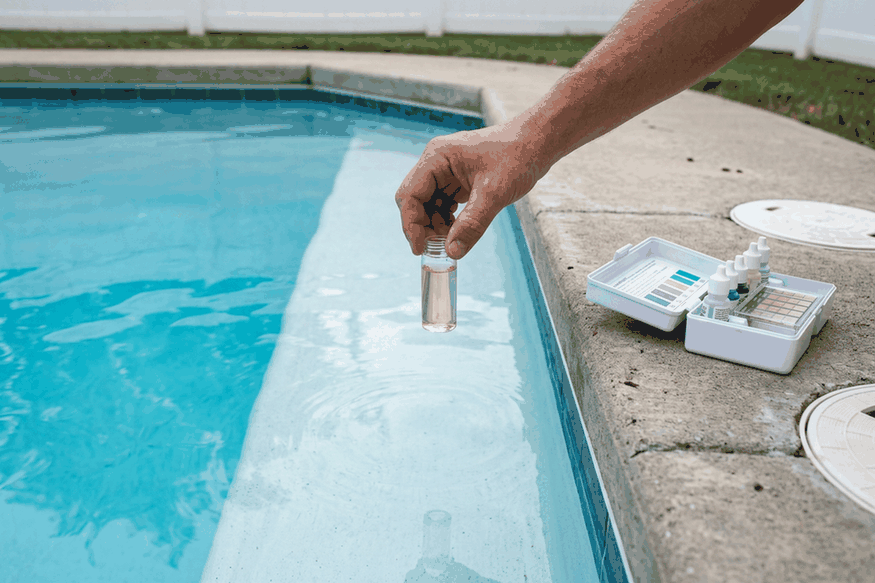
Your test kit gives you two numbers. Free chlorine is what is still available to sanitize the water. Combined chlorine is the portion that has already turned into chloramines. According to the CDC, combined chlorine should stay at 0.4 ppm (parts per million) or less. If it climbs past that, shock.
Why Does Pool Water Smell Musty?
That damp, musty odor is typically algae getting started, often before it is visible. Algae likes to settle where the sun does not reach: shaded walls, the backs of ladders, the skimmer throat, the steps, and any corner where the water hardly circulates.
To get rid of it, clear out blocked skimmers and keep the pump going longer. Shock, then keep the filter running around the clock for a day or two, and clean the filter over the days that follow.
When the Water Smells of Rotten Eggs
A sulfur or rotten egg smell can develop after a long shutdown, a power outage or poor circulation, or come from sulfur in the water used to fill the pool.
If the pump has been idle or running weakly, run it more, shock the water and inspect the filter. If the sulfur arrived with the fill water, aerating the water helps carry the smell off. Putting a filter on the hose end prevents it happening again.
What Makes Pool Water Sting Your Eyes
Chloramines bother your eyes, skin, nose and airways. Red eyes that sting and a strong smell share a cause, and they share a fix. Measure combined chlorine and shock when it goes over 0.4 ppm.
Fewer chloramines build up when swimmers rinse off quickly before entering. That rinse removes much of the sweat and body waste chlorine would otherwise absorb.
Shocking the Pool to Clear the Smell
- Begin with a water test so you know your free chlorine, combined chlorine and pH. Keep pH between 7.2 and 7.8 while you shock.
- If combined chlorine is above 0.4 ppm, the pool needs a chlorine treatment to remove chloramines; test first rather than choosing a dose based on smell alone.
- Add the shock, then run the pump so it spreads through the whole pool.
- Air out the space thoroughly while chlorine is high, as the CDC recommends.
- Wait until free chlorine drops back to its usual range before anyone swims.
Shock is sold in bags of various sizes, but you measure what you add by the pound, not by the bag. For routine shocking, or cloudy water with low chlorine, the dose is 1 lb of cal-hypo shock per 10,000 gallons. Light green or teal water needs 2 lb, darker green 3 lb, and black-green water or black algae 4 lb per 10,000 gallons. A strong smell alone does not tell you how much treatment is needed. The troubleshooter on the home page works out the amount for your own pool.
You can swap in liquid chlorine instead. For every pound of shock a 10,000-gallon pool needs, about 80 fluid ounces of 12.5% liquid does the same work. With a 10% product, pour about a quarter more.
Is It Safe to Swim When the Pool Smells?
Check the water before anyone swims, and skip swimming while any reading is off. Free chlorine should sit at 1 ppm at minimum. Public pools are held to a tougher standard: the bottom has to be plainly visible, and if the main drain is out of view from the side, the pool stays closed.
Common Questions
Does the chlorine smell come from pee?
Pee is one source. But chlorine also binds with sweat and cosmetics to create the same smelly chloramines, so a smell is not proof that someone urinated.
Why Does My Pool Smell Like a Pond?
Usually that earthy, pond-like odor means algae, the same culprit behind a musty smell. If it returns after shocking, the real problem is likely poor circulation rather than chemicals alone. Pay attention to how the water moves across your steps and into each corner.
Why Is the Smell So Strong Right After Adding Chemicals?
Certain products release fumes when poured. Move away and give the air time to clear. Never combine different pool products in one bucket.
Not quite your water?
Tap the photo that matches your water for the likely cause and the plan that goes with it.