
Troubleshooter › Cloudy water
Can You Swim in a Cloudy Pool?
No, you should not swim in a cloudy pool until the water is completely clear, even when the haze seems slight. Cloudy water can hide a swimmer in trouble, and it can mean germs or algae are growing because the chlorine is too low.
- The rule
- See the main drain or stay out
- Chlorine (CDC)
- At least 1 ppm in pools
- After a shock
- Wait 8 hours, then retest
- No main drain?
- You must see the whole floor
Not sure this is your water? Match your water by photo.
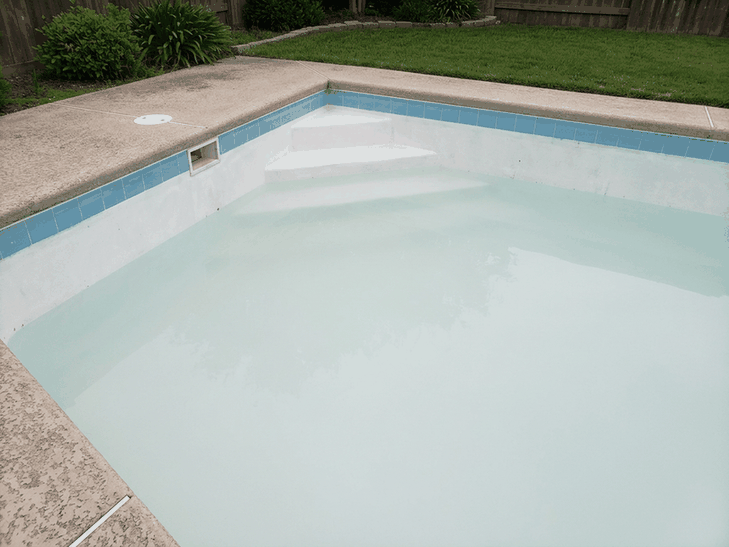
Is Cloudy Pool Water Safe to Swim In?
No. Two dangers come together here. One is that a child or a tired swimmer who slips beneath the surface cannot be spotted from the deck. The other is what the haze tends to mean: bacteria or algae may be multiplying because the water is not sanitized as it should be.
A pool that is only slightly milky is no exception. Even a faint haze counts as unsafe, and nobody should swim until the water is fully clear. Water like this can also be unbalanced or contaminated enough to sting skin and eyes or even cause illness.
Public pools follow the same rule. The CDC's Model Aquatic Health Code requires a clearly visible pool bottom, and the pool has to stay shut when the main drain can't be spotted from poolside.
Two Simple Checks Before Swimming
The main drain sits at the deepest point of the pool floor, covered by a grate. Look down from the edge and try to find it. If you cannot see it clearly, keep the pool closed, since anything down there, a person included, would be just as invisible.
The second check uses the first step. Stand on it and look straight down. If you cannot clearly make out your feet or your own shadow, the water is not safe. Both checks must pass.
Reasons the Water Goes Cloudy
When chlorine runs low, bacteria and algae take hold and make the water cloudy, though cloudiness can also signal a chemical imbalance or contamination. Chlorine gets consumed by pee, poop, sweat and grime that swimmers carry in, and sunshine eats away at it too.
The weather matters as well. Rain and storms dilute the chlorine and give bacteria room to multiply, so a pool can turn cloudy after a heavy downpour.
Then there is pH, because it controls how effective the chlorine can be. The pH is nothing more than a scale for how acidic the water is, and once pH rises past 8.0, chlorine loses its strength. On this site we aim for a pH between 7.2 and 7.8.
Making Cloudy Pool Water Safe Again
Two things make the water ready: you can see from the edge down to the drain, and the test numbers are where they belong. Wait to swim until the water is both clear and balanced, not one without the other.
With chlorine, the figure to watch is free chlorine, meaning the chlorine still free to fight germs. Test strips show it as ppm (parts per million), a measure of how strong the chlorine is. The CDC wants pools to hold a minimum of 1 ppm of free chlorine, with pH kept between 7.2 and 7.8.
At the right level, chlorine moves fast. Chlorine held at the proper level wipes out most bacteria in under 1 minute. Plenty of home pools also run stabilizer, a chemical known as cyanuric acid that shields chlorine from the sun. That helps, but germ killing slows down when stabilizer is in the water, which makes holding free chlorine at 1 ppm or above all the more important.
Frequent testing is what stops the pool from slipping back. The CDC recommends testing chlorine and pH no less than twice daily, since sun, rain and swimmers shift the numbers quickly.
Swimming After You Shock the Pool
Shocking means adding one big dose of chlorine to wipe out the germs and algae behind the haze. For a cloudy pool short on chlorine, the usual dose works out to 1 lb of cal-hypo shock for every 10,000 gallons. Hold pH in the 7.2 to 7.8 range while the shock does its work, because high pH weakens it.
After shocking, keep everyone out for at least 24 hours. Then swim only when the water is fully clear and properly balanced, not simply when chlorine reaches a minimum reading.
How Long Until a Cloudy Pool Clears?
That depends on how thick the haze is, so here are the two usual ranges together.
| Appearance of the water | Clearing time |
|---|---|
| Minor cloudiness | 24 to 48 hours |
| Severe cloudiness | 3 to 5 days |
Common Questions
What clears a cloudy pool fastest?
Shock the pool to raise the chlorine, and keep pH in the 7.2 to 7.8 range so the chlorine keeps its punch. Powdered shock can be swapped for liquid chlorine: roughly 0.6 gallon, that is 80 fluid ounces, of 12.5% liquid chlorine will match the effect of a pound of cal-hypo in a 10,000 gallon pool; with a 10 percent product, pour about a quarter more. Even the quickest fix still ends the same way: the water has to be clear before swimming.
Should I top up chlorine when the pool looks cloudy?
Often yes, since low chlorine is a common cause. The exception is when a test already reads at least 1 ppm free chlorine while the pH sits above 8.0. There the chlorine exists but is running weak, and easing the pH down to between 7.2 and 7.8 is the real fix.
What if the test strip reading is fine?
Stay out. A good strip reading only proves the chlorine and pH were fine at that moment. The haze is still dangerous on its own, because the main drain and anyone close to it stay hidden. The water must be both clear and balanced.
Get the plan for your pool size
Tap the photo that matches your water and type your pool size: the troubleshooter works out the shock in pounds and the liquid chlorine in gallons.