
Troubleshooter › Algae
Pool Algae
Algae in a pool is a growth much like a plant. It can turn the water green, leave a yellow dust in the shaded spots or make dark patches appear on the walls. A strong dose of chlorine shock plus a good stiff brush will kill it, and you should see the first signs of progress within a day.
- Green
- Clouds the water, brushes off easily
- Mustard
- Yellow dust in shady spots
- Black
- Raised spots that cling to plaster
- Can you swim?
- Wait 8 hours after a shock, then retest
Not sure this is your water? Match your water by photo.
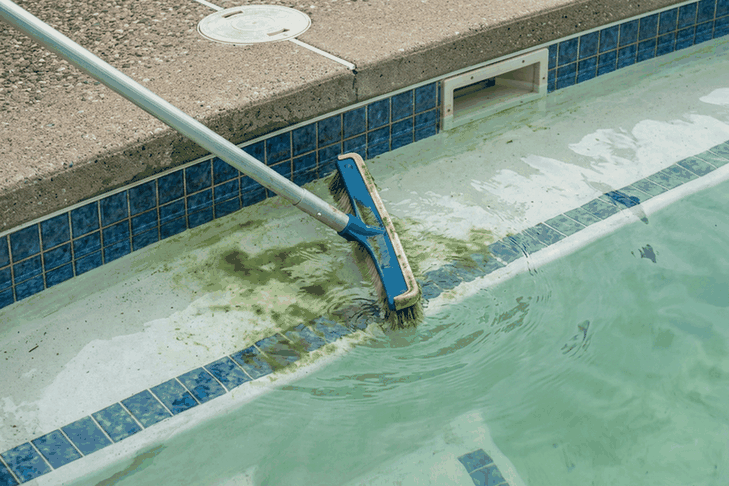
Three Types of Algae You May Find
Algae travels as spores, riding in on the wind, the rain or gear that touched another pool, so no pool is completely safe from it. It only takes hold if chlorine runs low, the water barely moves, or the filter works too few hours.
The kind you will meet most often is green algae. It makes the whole pool cloudy and sits on the walls, where it comes off with a light brushing.
Mustard algae shows up as a dust, yellow or brown in color, that collects where the shade sits. It brushes off without trouble, but it tends to return, since it sticks to toys, ladders and swimsuits and hitches a ride back into the pool.
Black algae grows as raised dark spots that hold tight to plaster. Getting rid of it is the hardest job of the three, because every spot wears a tough outer coating and root-like strands that push down into the surface. It gets started when the chlorine level is low.
Pool Algae Treatment Step by Step
Shocking with concentrated chlorine is the best treatment for killing algae, alongside thorough brushing and running the pump and filter all the time. Brushing counts for just as much, since chlorine can only attack algae once it has been freed from the walls.
- Start by testing the pH and adjusting it to 7.2 to 7.8. The pH tells you how acidic the water is, and chlorine does its best work inside this range.
- Give the entire pool a hard brushing, steps and corners included, to lift the algae off the walls and into the water where chlorine can get at it. Plan on brushing every day throughout treatment, because fresh layers keep coming loose.
- Put in the shock that matches your water color and let the pump and filter run without stopping until the water clears. Running all the time is what carries the chlorine to every corner of the pool.
- Clean the filter or backwash it each time you brush or vacuum. To backwash, you push water the wrong way through the filter to wash out everything it trapped, which lets it trap more again.
- Give it 12 to 24 hours. If the water turns cloudy after shocking, that's good news: it's a sign the algae has died. Keep the filter running so it can clear the water.
Black algae needs extra attention on every spot. Scrub the spot with a stainless steel brush or a pumice stone, press a trichlor chlorine tablet right against it, and finish with a full shock dose, so the chlorine can get through the broken outer layer.
The job is not over the moment the water looks blue again. Chlorine demand means the chlorine the water burns through each day, and it stays high while any algae is still alive. Keep up the brushing and the chlorine until the demand falls back to its usual level.
How Much Shock to Use Against Algae?
The greener and darker the water, the more chlorine you need. For every 10,000 gallons, use 1 lb of cal-hypo shock for cloudy water with low chlorine, 2 lb for light green or teal, 3 lb for darker green, and 4 lb for black-green water or black algae. The troubleshooter on our home page works out the exact amount for your pool's size.
Liquid chlorine works just as well, and about 0.6 gallon (80 fl oz) from a 12.5% jug does the same job as 1 lb of shock in 10,000 gallons. A weaker 10% version takes about a quarter more.
How to Prevent Algae in a Pool
Algae grows best where chlorine is low and the water stays still, so a steady weekly routine takes both away. Running the pump at least 8 hours every day keeps chlorine spread out evenly and carries spores into the filter system.
Check your water every week and hold free chlorine at 1 ppm or more, which is the lowest level the CDC recommends. A light shock each week of 1 lb for every 10,000 gallons helps keep algae from getting started.
Brush the walls and the floor 1 to 2 times a week. A brushing knocks spores off before they get a chance to settle in and multiply.
Stopping Algae After a Storm or a Busy Weekend
A heavy rain and a busy weekend have the same effect: both carry fresh spores into the pool and burn through chlorine fast. Shocking right after either one puts the chlorine back before anything gets a chance to grow.
Keep the pH in the 7.2 to 7.8 range at all times.
Above Ground Pools and Algae
An above ground pool clears up with chlorine and a brush just the same, though the surface changes the approach. A vinyl liner calls for gentler brushes and careful chemical handling, because a stiff wire brush or undissolved shock sitting on the liner can harm it.
The same amounts per 10,000 gallons apply, and the home page troubleshooter will size the dose for your pool. During treatment run the pump the whole time, and backwash or rinse the filter after every brushing, just as you would in a bigger pool.
Pool Algae: Questions People Ask
Is swimming safe when algae is present?
The rules for public pools offer a handy check. The CDC Model Aquatic Health Code requires water clear enough that the floor is visible, and the main drain must be in view from the side or the pool stays closed. Any pool that misses this mark is not ready for swimmers.
Can You Kill Algae Without Chlorine Shock?
No. A non-chlorine shock only oxidizes; it does not sanitize, so it strips out some waste yet the algae lives on.
Do Algaecides Clear Up Algae?
An algaecide works only as a supplement. It cannot stand in for chlorine, brushing, circulation or filtration. Where it helps most is in stopping algae before it starts, not in cleaning up a pool whose color has already changed.
What Brings Mustard Algae Back Again and Again?
Because it lives outside the water too. Mustard algae grips onto gear and cloth, so even a well treated pool gets reinfected by toys, floats and swimsuits. While treating, take toys, vacuum heads and ladders away and give them a wash, so nothing carries it back.
Not quite your water?
Tap the photo that matches your water for the likely cause and the plan that goes with it.