
Troubleshooter › Cloudy water
Pool Cloudy But Chemicals Are Balanced
If your pool is cloudy but the chemicals test balanced, the culprit is usually the filter, or a pump that isn't running long enough. Water can read perfect on a test and still look dull, because a test kit only tells you about the chemistry. It says nothing about how well the filter is doing its job.
- Likely cause
- The filter or its run time
- Pump run time
- At least 8 hours a day
- Next step
- Clean or backwash the filter
- Can you swim?
- Not until you can see the main drain. That is the grate at the deepest point, and free chlorine should read 1 to 4 ppm (parts per million).
Not sure this is your water? Match your water by photo.
Begin With the Baskets and the Gauge
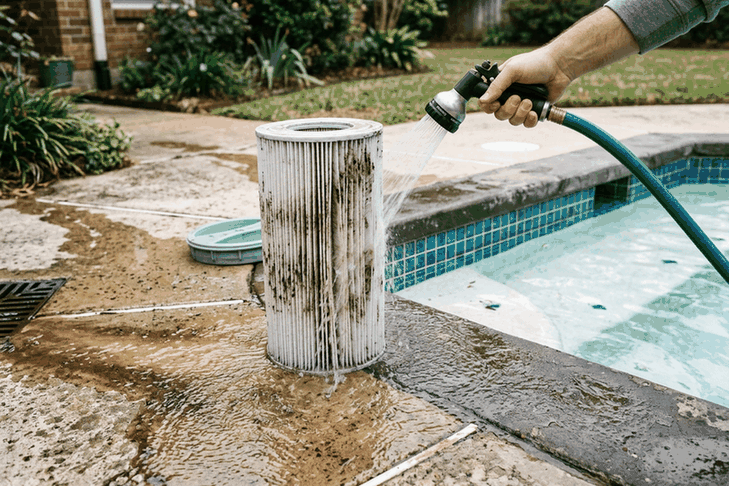
Circulation is the first thing to check when the numbers look good. Clear out the pump strainer and skimmer baskets, then glance at the filter pressure gauge.
The clean reading on the gauge is the number you see right after a filter cleaning. Once it climbs to 8 to 10 psi above that, it is time to clean or backwash. While the haze lasts, keep the filter going all day and all night for now.
If you have a sand filter, be patient: sand clears haze slowly, so it helps to run the pump for longer.
Vacuuming to Waste
A lot of debris, especially fine silty dirt, can clog a filter fast. When the mess is that kind, vacuuming to waste is the better move. To vacuum to waste, switch the pump off before moving the filter valve to "waste," so the dirty water you vacuum leaves the pool directly instead of passing through the filter.
This method drains water in a hurry, so get ready first.
- Top the pool up a bit past its normal level, so you have water to lose.
- Keep a garden hose running in the pool the whole time you vacuum.
- Vacuum quickly, since the level falls fast.
- Stop as soon as the skimmer starts sucking air, and let the pool refill before you carry on.
Why Does Vacuuming Leave My Pool Cloudy?
If the water turns hazy every time you vacuum, even right after cleaning the filter, the filter itself may be worn out.
The sand inside a sand filter lasts about 5 to 7 years. Once it wears out, filtering suffers and the pressure stays high no matter how much you backwash. With a DE filter (one that uses a fine powder called diatomaceous earth on grids), a milky white cloud in the water points to grids that may have holes in them.
How to Backwash a Sand Filter
Backwashing means sending water through a sand or DE filter backwards, so the dirt it trapped washes away. It is one part of clearing hazy water, and on a sand filter the steps are these.
- Power the pump down before laying a hand on the valve handle. The handle should never be moved while the pump runs.
- Move the handle to backwash, switch the pump on and let it run about 2 to 3 minutes, long enough for the sight glass (the small window on the filter valve) to run clear.
- Turn the pump off again, move the handle to rinse, and run it for about 30 seconds.
- Shut the pump off once more and return the handle to filter.
Never send backwash water into a storm drain, because that is against local, state and federal regulations.
Still hazy after a backwash? Two things are worth a look. Oils can stay behind in a filter after backwashing, and a filter cleaner will strip them out if you follow the label. If the pressure stays high even right after a backwash, the sand itself is probably worn out and due for replacement.
After a Busy Swim Day
A crowd in the water brings a lot of waste from swimmers, and that can swamp the chlorine and the filter together. Once the last guest is out, test the water.
Free chlorine is the chlorine that is still free to do its work, and it is the figure your test gives you. The CDC says pools should have at least 1 ppm (parts per million, the unit on the test strip or kit) of free chlorine. If the water is cloudy and free chlorine is below 1 ppm, it needs a shock, which is a large dose of chlorine that clears haze and algae. Use one of these for each 10,000 gallons, and never use both:
| Product | Dose for each 10,000 gallons |
|---|---|
| Shock powder, 65% cal-hypo (calcium hypochlorite) | One pound |
| Liquid chlorine at 12.5% | Around ⅗ of a gallon, or 80 fluid ounces |
The pool-size tool on the home page works out the dose for your own pool, including for 10% liquid chlorine. Powdered shock brings calcium with it, so if calcium hardness (how much dissolved calcium the water holds) is already over 400 ppm on a test, go with liquid chlorine. Keep the pH in the 7.2 to 7.8 range while chlorinating, and keep the filter running day and night until the haze lifts. The CDC warns that mixing pool chemicals or handling them without protective gear can cause injuries, so never mix them and follow the label's directions on handling and protective gear.
Adding a Water Clarifier
When the balance is good and the filter is clean and running as it should, a water clarifier comes next. A clarifier is a liquid that gathers tiny particles into clumps big enough for the filter to grab. Once it is in, leave the pump running nonstop on high speed until the water clears.
Are Calcium and Dissolved Solids to Blame?
A pool can go hazy even when the free chlorine number looks good. Calcium hardness that runs high, along with high total dissolved solids (everything dissolved in the water), can each cause cloudiness, so test for them when the usual numbers all check out.
Is It Safe to Swim in Cloudy Water?
Nobody should take a dip in a cloudy pool, because hazy water is a genuine safety risk. The CDC Model Aquatic Health Code says a public pool cannot open if the main drain cannot be seen from poolside, and at home you should use that check too, along with free chlorine and pH, before anyone swims. You can swim again once three things are true. First, you can see the main drain from the side. Second, free chlorine reads 1 to 4 ppm, or at least 2 ppm if your pool uses stabilizer, the chemical that shields chlorine from sunlight. Third, pH is between 7.2 and 7.8.
Questions People Ask
Should more chlorine go in when the pool is cloudy?
Only when the test says so. Clear water with free chlorine a touch low just needs a top-up of liquid chlorine: 10 fl oz of 12.5% lifts 10,000 gallons by 1 ppm. Shocking is meant for hazy water whose free chlorine has slipped below 1 ppm, or for green water; a merely low reading does not call for it.
Why is the reading lower than expected after a shock?
The amount on the label is what the shock should add in theory, and your test will usually read lower because dirt and algae start using up chlorine right away. A pound of 65% cal-hypo should raise 10,000 gallons roughly 8 ppm in theory, but whatever is in the water burns through chlorine straight away, leaving the test lower. Most strips also top out near 10 ppm, which is why a FAS-DPD drop kit, the kind that measures very high free chlorine, gives a truer reading.
How can I tell the shock is done?
Do a test once the sun sets, then repeat before it comes up. The treatment has worked when free chlorine loses no more than 1 ppm through the night and the water looks clear. If it sinks further, something in the pool keeps consuming chlorine.
Not quite your water?
Tap the photo that matches your water for the likely cause and the plan that goes with it.