
Troubleshooter › Cloudy water
How to Clear Cloudy Pool Water
Learning how to clear cloudy pool water starts with the cause, which is commonly poor filtration, unbalanced chemicals or early algae growth. Start by brushing the pool and testing the water, then work through the steps to fix the cause. If the haze hangs on after a day or two of filtering, you may need a clarifier or flocculant.
- Filter
- Run it around the clock until clear
- Shock if chlorine is low
- 1 lb per 10,000 gallons
- A light haze clears in
- A day or two
- Can you swim?
- Not until you can see the main drain. That is the grate at the deepest point, and free chlorine should read 1 to 4 ppm (parts per million).
Not sure this is your water? Match your water by photo.
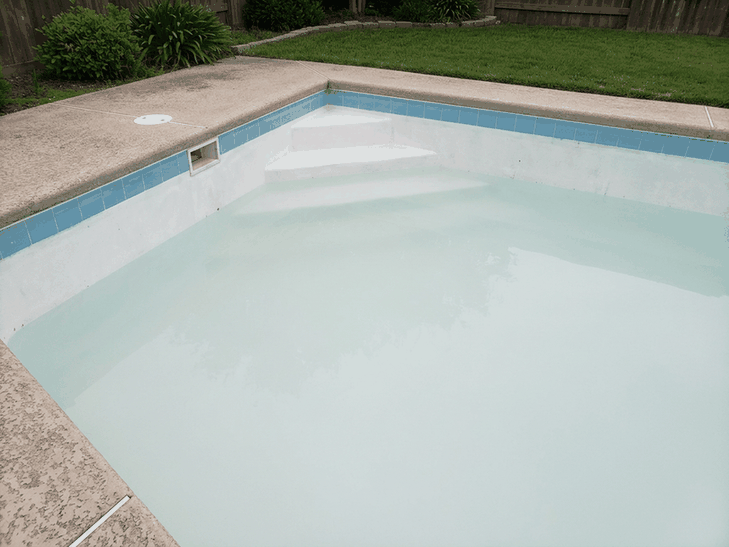
Shock at Night, Then Filter
Do the whole job in one evening and let the pool sort itself out while you sleep. Shock is chlorine at a heavy dose, strong enough to kill algae and bacteria, and it works best at night since sunlight would break it down. A cloudy pool short on chlorine needs a pound of shock (cal-hypo) for every 10,000 gallons; if the water looks faintly green or teal, use twice as much. Liquid chlorine at 12.5% strength does the same job: roughly 0.6 gallon, or 80 fl oz, matches a pound of cal-hypo shock, and a 10% jug takes about a quarter more.
After that, the filter carries the load. Keep it going for 24 to 48 hours after shocking, since every pass traps a few more of the particles that give the water its milky look. Try not to switch the pump off early, because the filter needs that time to catch the last of the haze.
Step by Step
Do the steps in this order, because each one helps the next one along.
- Start by brushing the walls and floor. That knocks loose anything clinging to the surfaces so the filter can grab it.
- Test the water, then bring it into balance, starting with alkalinity, moving on to pH, and finishing with chlorine. Keep alkalinity between 80 and 120 ppm. pH shows where the water sits on the acid-to-base scale; keep it between 7.2 and 7.8. When pH runs high, the water clouds, the chlorine weakens and scale builds on the walls, sorting that out alone can sometimes lift a light haze.
- Should free chlorine come in under the 1 ppm level the CDC advises, add a pound of shock (cal-hypo) for every 10,000 gallons once the sun is down.
- Keep the filter going for 24 to 48 hours. Check the filter's pressure gauge once or twice along the way. If it reads 8 to 10 PSI higher than it does when the filter is clean, clean or backwash the filter so it can keep catching dirt.
- If two days of filtering have not done the trick, a clarifier is the next move; leave the pump running.
When the pool is clear again, keep the pump going at least 8 hours every day. Still water skips the filter, and skipping the filter is how a clear pool slides back into haze.
Match the Fix to the Cause
Weak filtration, off-balance chemistry and algae getting started are the three usual suspects, and each one calls for a different fix.
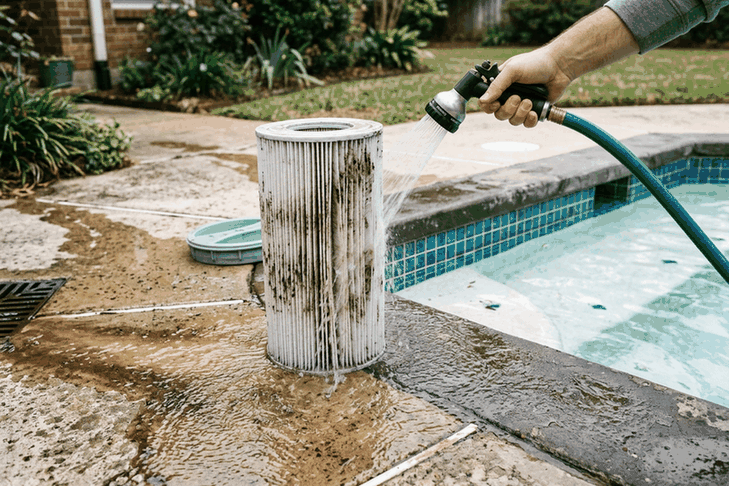
If the chemistry tests fine but the water looks dull, look at the filter first. The sand in a sand filter has a lifespan of about 5 to 7 years; past that it filters poorly even while the pump seems to run fine. Rinse cartridge filters with a hose, and never use a pressure washer on them.
If pH or alkalinity is off, the fix is balancing, and the cloud usually fades by itself once the pump has pushed the corrected water around. A faint green tint or steps that feel slippery mean algae is getting started, and shock takes care of it. Hazy water right after you shock is a sign the algae is dead, not a sign you did something wrong. Vacuum, filter and a clarifier wrap it up.
Clarifier or Flocculant
Both products exist for haze that good chemistry and a clean filter cannot budge. A clarifier is a liquid that gathers tiny particles into clumps the filter can catch. A flocculant works the other way: it glues particles into heavy clumps that drop to the bottom, and you then vacuum them out.
| Clarifier | Flocculant | |
|---|---|---|
| How it clears | Filter traps the clumps | Clumps drop to the floor |
| Pump while treating | Run for a day or two | Off so particles can settle |
| Wait for results | As long as 48 hours | 8 to 12 hours of settling |
| Cleanup afterwards | None | Vacuum to waste |
For clarifier, run the pump 24 to 48 hours and hold off on backwashing or cleaning the filter for a full 24 hours, since the filter is collecting those clumps. If 48 hours pass without clear water, inspect the filter and re-test the chemistry before pouring in more.
For flocculant, give the particles 8 to 12 hours to sink, then vacuum the floor to waste, which pushes the dirty water out of the pool rather than through the filter. Plenty of above-ground pools have no setting for that, so those pools should use clarifier instead.
Common Questions
Is Cloudy Pool Water Okay to Swim In?
The rule used by public pools is a handy guide for home. The CDC Model Aquatic Health Code demands water transparent enough to show the bottom, and a pool stays closed when the main drain cannot be spotted from the deck. If the deep end floor is hidden, swimmers should stay out of the water.
Why Does Cloudiness Linger When the Chemicals Check Out?
If all your readings land in range, the culprit is usually weak circulation, a filter that is dirty or clogged, fine bits of algae remaining after a treatment, or pollen and dust carried into the water. One case stands apart: a white, powdery cloud appearing the moment the pump kicks on. On a DE filter, that points to torn grids inside letting filter powder seep back into the pool.
Do You Need Chemicals to Clear a Cloudy Pool?
Occasionally not, as long as the chemistry already tests in range. Brush the walls and floor, clean the filter and keep the pump going day and night for a day or two; a light haze from dust or pollen may lift. If chlorine sits under 1 ppm or the water shows the slightest green, filtering alone won't manage it.
Not quite your water?
Tap the photo that matches your water for the likely cause and the plan that goes with it.