
Troubleshooter › Green water
Green Pool Water
Algae is the most common cause of green pool water, especially when the water is cloudy. It moves in when chlorine runs low, becomes unstable or gets blocked from doing its job. Some green pools, though, have no algae in them at all. In those cases, metals like copper or iron are coloring the water, and they call for a different kind of fix.
- Likely cause
- Algae fed by low chlorine
- Shock
- 2 to 4 lb per 10,000 gallons
- Light green clears in
- 24 to 48 hours
- Can you swim?
- Not until you can see the main drain. That is the grate at the deepest point, and free chlorine should read 1 to 4 ppm (parts per million).
Not sure this is your water? Match your water by photo.
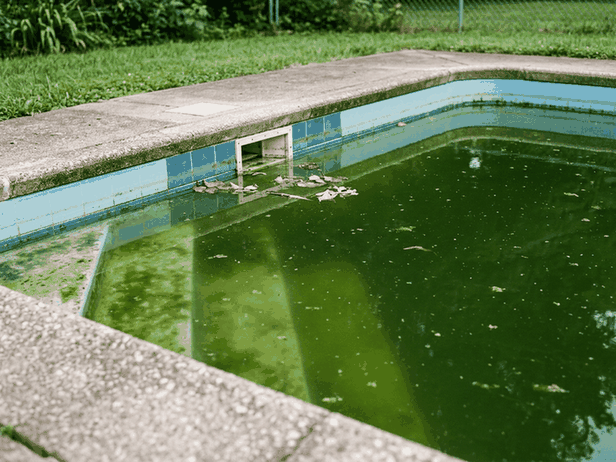
What Causes Green Pool Water?
Algae is the usual culprit behind water that turns green and cloudy. It gets a foothold when chlorine runs low, the pH is off balance or the water gets warm. When a pool has algae, chlorine has usually slipped low and phosphorus may be running high.
pH alone can matter too. Water can pick up a green tint once the pH climbs past 7.8, which is why the advice here is to keep a pH of 7.2 to 7.8.
Metals are the next big cause. Too much iron, copper, manganese or hardness can bring on a green color even when no algae is present. A green or blue-green tint most often points to copper.
Why Does a Pool Go Green Again and Again?
When a pool goes green over and over, even though chemicals are in it, the trouble usually comes down to water chemistry that has drifted off balance or chlorine that has stopped doing its job. Pouring in more of the same product seldom helps, so start with a full water test.
That test should look at free chlorine, pH, total alkalinity (what keeps the pH steady) and stabilizer, and now and then phosphates or metals too. Free chlorine means the share of chlorine that is still ready to work, and it is what your test measures. Stabilizer, also called cyanuric acid, protects chlorine from the sun.
Pool Turned Green Overnight
If a pool goes green overnight or after it rains, the reason is often a pump that is not moving the water around as it should. Algae can multiply fast in still water. Before adding anything, make sure the pump is on and water is moving through the filter.
Pool Green but Chlorine High?
If the water is green even with a high free chlorine reading, check the stabilizer and pH. When stabilizer piles up, chlorine loses its effectiveness, even with plenty showing on the test. A high pH, a built-up stabilizer level or warm water all mean the pool needs extra chlorine to get the same result.
The test itself can mislead you too. Most strips only read up to about 10 ppm (parts per million, the unit on the test), so while treating algae, use a drop test kit that measures high free chlorine. You will find these kits sold under the name FAS-DPD.
Pool Water With a Green Tint You Can See Through
Water that looks green yet stays clear enough to see through usually points to metals, and a sequestrant can tie them up. A sequestrant is a liquid treatment that latches onto the metals so they quit tinting the water. Clear green water that shows up right after a shock is usually metal as well, and more shock only makes things worse, because a shock will not clear metals out and may leave stains.
How to Shock a Green Pool
Shocking means pushing chlorine up to a very high level to wipe out algae. For algae, use a chlorine shock, not a non-chlorine one.
- Start with a water test so you can tell whether algae or metals is the trouble.
- Bring the water to a pH of 7.2 to 7.8 before you shock, since chlorine does a poor job when the pH runs high.
- Leave the pump on so the shock circulates through every part of the pool.
- Match the dose to the water color, and pick just one shock, cal-hypo or liquid chlorine, never the two together.
- Test each day and keep a pH of 7.2 to 7.8 for as long as the chlorine stays high.
Pool chemicals can hurt people when they are combined or used without proper protection, the CDC warns. Never mix pool chemicals.
Shock Amounts by Water Color
The amounts below work for every 10,000 gallons of water in the pool. The cal-hypo figures assume powdered shock at about 65% strength. The liquid amounts assume chlorine at 12.5% strength, and a 10% bottle needs about a quarter more.
| Shade of green | Cal-hypo | Liquid chlorine (12.5%) as an alternative |
|---|---|---|
| Pale green or teal | 2 lb | About 0.6 gallon for each 1 lb of cal-hypo |
| A deeper green | 3 lb | About 0.6 gallon for each 1 lb of cal-hypo |
| Black-green growth or black algae | 4 lb | About 0.6 gallon for each 1 lb of cal-hypo |
Type your pool size into the box on the home page and it works out the amounts for your pool. Buy enough shock to make up the amount your pool needs, and add just that much. Cal-hypo also puts calcium into the water. When calcium hardness already tests above 400 ppm, liquid chlorine is the better pick.
After a shock, the free chlorine test will read lower than what you put in. The algae and debris burn through the chlorine right away.
How Long Does Clearing Take by Shade?
Water that is only light green and caught early typically clears up within a day or two. Water that is dark green or black can need five to seven days, and sometimes more. If the water turns cloudy after a shock, it means the algae has died, and the filter will gradually clear it away.
The treatment is complete once the water runs clear and free chlorine drops by no more than 1 ppm overnight. To check it, test once the sun sets, then again before it rises. A bigger drop means something in the pool is still eating the chlorine.
Questions People Ask
Is green pool water safe to swim in?
No. People should keep out of water that looks green, murky or slimy. No one should swim until the main drain (the grate down at the deepest point) is visible from the side. The water must also test at 1 to 4 ppm of free chlorine, with at least 2 ppm where the pool uses stabilizer, and a pH of 7.2 to 7.8.
Why did my pool go green after I shocked it?
A greenish tint that appears once a shock has been added points to metals dissolved in the water, often left there when the pool was filled from a well. Even so, a metal problem is not behind every pool that loses its color, so a metals test is how you sort one from the other.
Not quite your water?
Tap the photo that matches your water for the likely cause and the plan that goes with it.