
Troubleshooter › Green water
How to Clear a Green Pool
A green pool usually clears when you confirm the green really is algae, adjust pH (how acidic or basic the water is) to somewhere between 7.2 and 7.8, then give the water a strong shock dose in the evening and let the filter keep working until the water looks clean. For most pools that takes several days to a week, not a single night.
- Shock
- 2 to 4 lb per 10,000 gallons, by shade
- Filter
- Around the clock
- Dark green takes
- 5 to 7 days, sometimes longer
- Can you swim?
- Not until you can see the main drain. That is the grate at the deepest point, and free chlorine should read 1 to 4 ppm (parts per million).
Not sure this is your water? Match your water by photo.
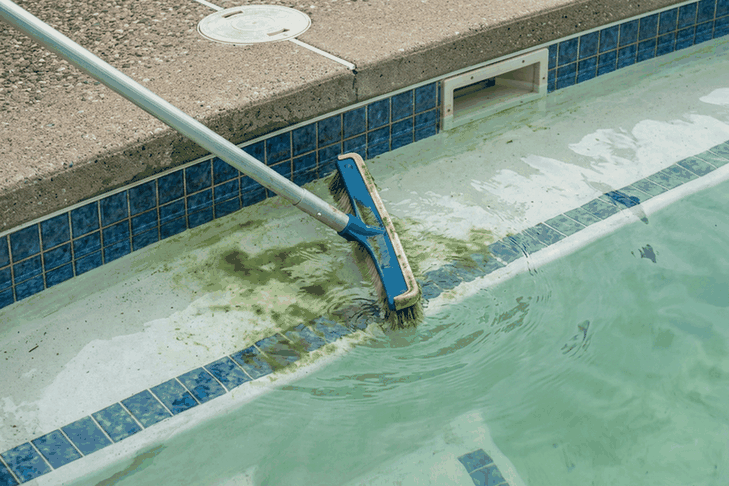
Checking It Is Algae First
Green water can come from algae or from metals. If the water stays clear but takes on a green or blue-green tint, particularly just after a shock, the usual culprit is a metal such as copper. Adding more shock will not clear metals out. It actually pulls them out of the water and leaves stains on the pool. Algaecides made with copper can put extra copper in the water when they are not used the way the label says. Even so, a pool with odd color is not always a metal issue.
If metals turn out to be the problem, you treat them with a product called a sequestrant. Once it is in, run the pump for 24 to 48 hours and hold off on shocking for 3 to 4 days.
Shock Amounts by Shade of Green
Shock means a big chlorine dose that wipes out algae. For a green pool, go with calcium hypochlorite rather than stabilized shock. Calcium hypochlorite is the standard powdered shock. The amounts below are for each 10,000 gallons of water.
| Shade of the water | Powdered shock for each 10,000 gallons |
|---|---|
| Teal or a pale green | 2 lb |
| A deeper green | 3 lb |
| Green that looks almost black | 4 lb |
The pool-size box on the home page works out the amount for your own pool, whether you use powdered shock or liquid chlorine.
You can swap liquid chlorine for powdered shock, but never use them together. Powdered shock raises calcium, so switch to liquid chlorine when your calcium hardness (how much dissolved calcium the water holds) test comes back above 400 ppm (parts per million, what the test reads). Add each chemical on its own and wear gloves and eye protection. The CDC warns that pool chemicals can injure people when they are mixed together or handled without protective gear.
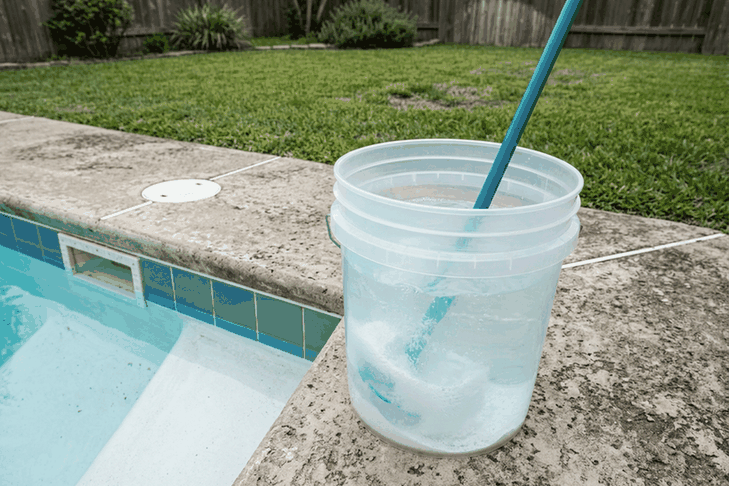
How to Get the Water Clean
- Start with a pH check and nudge it to 7.2 to 7.8.
- Hold off until evening, when the sun will not eat up the chlorine so fast.
- Put in the shock dose that matches your shade of green.
- Let the filter run, which can take 24 hours up to a week after treating algae.
- When you can still see algae, repeat the shock the following evening.
- After the algae dies, vacuum the floor and leave the filter going.
While you have the test kit out, check stabilizer (cyanuric acid), which protects chlorine from sunlight. The Illinois Department of Public Health recommends 25 to 50 ppm; if yours is over 100 ppm, drain off part of the water and refill.
Can a Green Pool Clear Overnight?
In most cases, no. Shock needs 12 to 24 hours to finish off algae, and then the dead algae still has to be filtered or vacuumed away. That said, one night can bring genuine improvement. Green water often looks cloudy by morning, and that cloudiness after a shock is a sign the algae has died.
Helping Cloudy Water Clear
If the water is cloudy after shocking, vacuum and keep the filter running; a clarifier, a liquid that clumps fine particles so the filter can catch them, can also help. A flocculant is a liquid that drags the dead algae cloud down to the floor. It needs the night to settle. Then vacuum to waste, which means turning the filter valve to "waste" so the water you vacuum leaves the pool rather than going through the filter.
What Happens as It Clears
Once the water has gone from green to cloudy, the hard part is over: what is left is dead algae that filtering, vacuuming or a flocculant will take out. Over the next few days the cloud fades as the filter, the vacuum or a flocculant clears away what's left.
Two products can help near the end. Wait 24 hours after the shock before adding algaecide, a chemical that kills algae. After you add a clarifier, keep the filter going for at least 8 hours.
You are done once the water looks clear and the overnight loss of free chlorine is 1 ppm or less. Free chlorine is the portion of chlorine left over to do the sanitizing, and it is the figure your test gives you. Test after the sun goes down, then again before the sun comes up. If the level sinks much further than that, something in the water is still burning through chlorine.
When Can You Swim Again?
Give it at least 8 hours after a shock before letting anyone get in. Even after that, hold off on swimming until you can see the main drain, the grate at the pool's deepest point, from the side. Before swimming, free chlorine must be 1 to 4 ppm, or 2 to 4 ppm if you use stabilizer, and pH must be 7.2 to 7.8. The CDC is the source for these figures. Public pools must meet the drain standard spelled out in the Model Aquatic Health Code.
Common Questions
Why does the pool stay green even with a high chlorine reading?
When clear water turns green after a shock, copper or iron is the likely cause, not algae, and more shock only deepens the problem. Most test strips stop at about 10 ppm. During algae treatment, use a drop test kit that measures high free chlorine, such as one labeled FAS-DPD.
Why is the chlorine reading lower than expected after a shock?
Don't worry if the free chlorine test reads lower than you hoped. Algae and debris start using up chlorine the moment the shock goes in, so a low reading is normal while you're still fighting algae.
Is shocking the answer every time chlorine runs low?
Not at all. If the water looks clear and the free chlorine is just a touch low, a top-up of liquid chlorine will do. Shock is meant for green water, or for cloudy water where free chlorine sits under 1 ppm.
Not quite your water?
Tap the photo that matches your water for the likely cause and the plan that goes with it.