
Troubleshooter › Cloudy water
Pool Cloudy After Adding Chemicals
A cloudy pool right after adding chemicals is usually a reaction between the new chemical and what's already in the water, such as calcium or a pH that has crept too high. Freshly added shock is the one exception: granular shock needs around 24 hours to fully dissolve and clear. If the haze hangs around past that, something deeper is going on.
- Usual culprits
- Calcium, baking soda, stabilizer
- Check first
- pH above 7.8
- Usually clears in
- 24 to 48 hours
- Can you swim?
- Not until you can see the main drain. That is the grate at the deepest point, and free chlorine should read 1 to 4 ppm (parts per million).
Not sure this is your water? Match your water by photo.
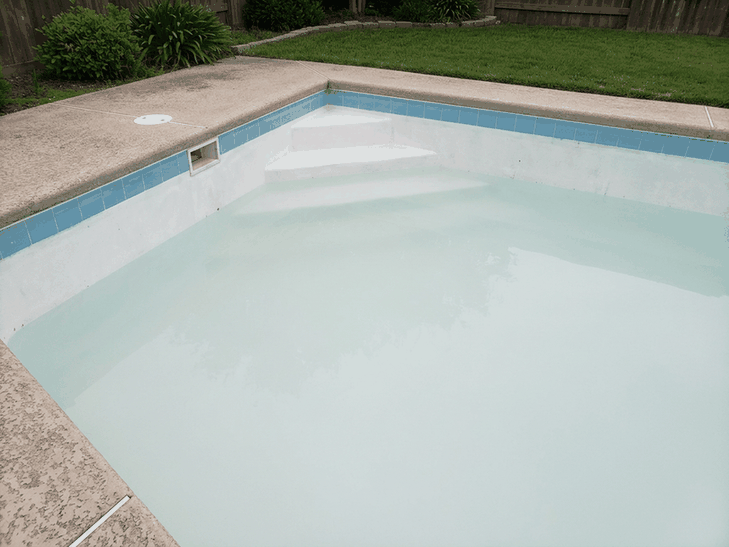
What Causes the Cloud?
Chlorine is what clears a pool, so when a cloud appears it is almost always a response to something else sitting in the water. The usual causes are calcium dropping out of solution as tiny white specks, a pH that has drifted up too far, or stabilizer that has piled up over the seasons.
Your test kit gives you the pH, a number that shows how acidic the water is. Pools do best between 7.2 and 7.8. Climb above that band and the water may turn hazy, the chlorine loses some of its power, and scale can start building on surfaces and gear.
Calcium hardness simply means how much calcium is dissolved in the pool, and the target range is 200 to 400 ppm (parts per million, the unit test kits use). Water heavy in calcium turns cloudy unless alkalinity or pH sits low enough to hold it in balance.
Before you add anything else, test the water so you know what you're fixing. Get alkalinity right first, then pH, because alkalinity is what holds pH steady. While you're at it, check calcium and stabilizer too.
Cloudiness After Baking Soda Goes In
Baking soda pushes total alkalinity up, and alkalinity is what keeps the pH from wandering. If the water already holds a lot of calcium, extra alkalinity upsets the balance that was keeping that calcium dissolved. Soon after the baking soda goes in, a milky haze shows up.
A calcium hardness test will show whether your pool fits that picture.
Adding Calcium Too Close to Baking Soda or Soda Ash
Put calcium chloride in within a few hours of baking soda or soda ash and the water will turn cloudy. To avoid this, space the calcium treatment and the alkalinity products apart on different days or at least well away from each other.
Also, do not pre-dissolve calcium chloride in a bucket. Instead, scatter it across the water surface with the pump running so it spreads evenly.
Does Chlorine Itself Cloud a Pool?
Not on its own, since chlorine is what clears a pool. But adding it can nudge the pH up for a while, and that short-lived rise is enough to leave some calcium behind as a fine white haze.
The product you poured matters too. Some household bleach has extra ingredients mixed in, so it helps to read the label and check if what you added was plain pool chlorine or a bleach with extras in it.
Metals in the water can also react to chlorine, though they tend to give a green or brown tint rather than a milky one. A white or gray cloud usually traces back to calcium or pH.
Using Acid to Lower a High pH
Muriatic acid brings pH down, but go gently, because an overdose can push the pH down to unsafe levels and damage metal equipment.
- Start the pump before you begin, so the acid moves through the pool instead of pooling in one place.
- Never add water to acid.
- Dose small, let it circulate, then test again to stay within the 7.2 to 7.8 band.
Bringing Down Excess Calcium or Cyanuric Acid
Cyanuric acid, the sun-shield for chlorine that most people call stabilizer, can add to the haze when it builds up too high. The target level is 30 to 50 ppm. If your reading sits above that, moving to unstabilized chlorine stops it from climbing further.
To lower high stabilizer, drain part of the pool and refill it; to lower high calcium hardness, the replacement water needs to have lower calcium hardness.
Questions People Ask
What if the water is cloudy and the chlorine keeps vanishing?
If chlorine falls close to zero within a day or two, shock at double or triple the usual strength: two or three pounds of cal-hypo for every 10,000 gallons, against a standard dose of one pound per 10,000 gallons.
Is liquid chlorine an acceptable substitute for granular shock?
Yes. For a 10,000-gallon pool, roughly 0.6 gallon of 12.5% liquid chlorine, about 80 fluid ounces, matches the effect of one pound of cal-hypo shock, and with a 10% jug you use about a quarter more. The troubleshooter on our home page will work out the right amount for your own pool's size.
What chlorine level should remain once the water clears?
The CDC advises keeping free chlorine at 1 ppm or more in pools, with the pH kept at 7.2 to 7.8 while chlorinating.
How clear does the water need to be?
Public pools are held to a plain standard set by the CDC Model Aquatic Health Code. The floor of the pool has to be visible, and a pool cannot open unless the main drain is visible from the side.
Get the plan for your pool size
Tap the photo that matches your water and type your pool size: the troubleshooter works out the shock in pounds and the liquid chlorine in gallons.