
Troubleshooter › Green water
How Much Shock for a Green Pool
One evening's starting dose by pool size and how green the water is. Light green usually clears in 24 to 48 hours; nobody swims until you can see the main drain.
| Pool size | 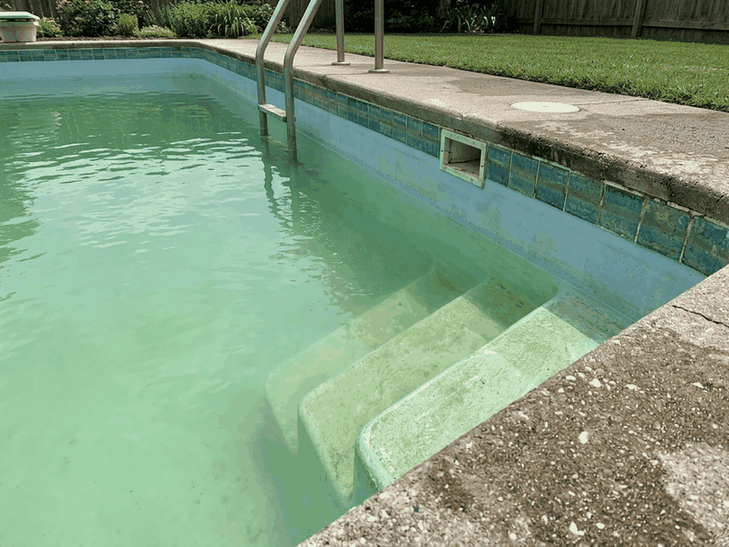 Light green | 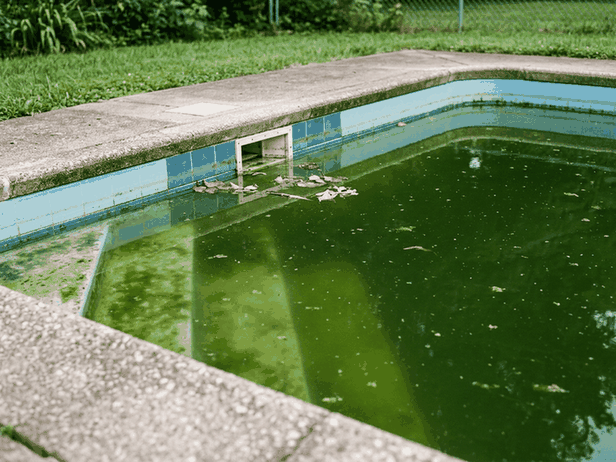 Dark green | 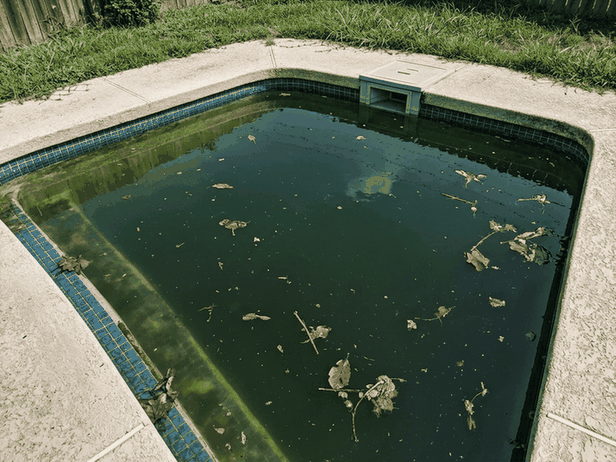 Black-green |
|---|---|---|---|
| Use one: shock in lb (65% cal-hypo), or liquid chlorine in gal or fl oz (12.5%) | |||
| 2,500 gal | ½ lb or 40 fl oz | ¾ lb or 60 fl oz | 1 lb or 0.6 gal |
| 5,000 gal | 1 lb or 0.6 gal | 1.5 lb or 0.9 gal | 2 lb or 1.3 gal |
| 10,000 gal | 2 lb or 1.3 gal | 3 lb or 1.9 gal | 4 lb or 2.5 gal |
| 15,000 gal | 3 lb or 1.9 gal | 4.5 lb or 2.8 gal | 6 lb or 3.8 gal |
| 20,000 gal | 4 lb or 2.5 gal | 6 lb or 3.8 gal | 8 lb or 5 gal |
| 25,000 gal | 5 lb or 3.1 gal | 7.5 lb or 4.7 gal | 10 lb or 6.3 gal |
| 30,000 gal | 6 lb or 3.8 gal | 9 lb or 5.6 gal | 12 lb or 7.5 gal |
| 40,000 gal | 8 lb or 5 gal | 12 lb or 7.5 gal | 16 lb or 10 gal |
- Light green clears in
- 24 to 48 hours
- Dark or black-green
- 5 to 7 days, sometimes longer
- While it clears
- Brush daily, run the pump around the clock
- Can you swim?
- Not until you can see the main drain. That is the grate at the deepest point, and free chlorine should read 1 to 4 ppm (parts per million).
Check first: clear green right after a shock is usually metal, not algae.
10% jugs: use a quarter more than the liquid amount in the table; the size box shows both strengths.
Doses assume a normal stabilizer level of 25 to 50 ppm (parts per million); with more stabilizer, chlorine works more slowly.
The greener your pool looks, the more shock it will take, starting at 2 lb per 10,000 gallons when the water is light green and rising to 4 lb when it is black-green. Shock is chlorine in a big dose, and it wipes out algae and cloudiness. Most people use cal-hypo (calcium hypochlorite), a chlorine powder that usually comes at 65% strength.
Shock usually comes in one-pound bags and liquid chlorine in one-gallon jugs. Put your pool size into the box on this page and it will tell you how many bags or jugs to buy. You only need one or the other.
Pick the powder or the liquid, and do not combine them. Mixing pool chemicals can injure anyone nearby, and the CDC warns that handlers who skip protective gear get hurt too.
How Much Chlorine Kills Algae?
Shock raises your free chlorine a lot, but don't expect the test to match what you added. Algae starts using chlorine the moment it goes in, so the reading will come out lower, and that's normal.
The reading that counts is free chlorine, the chlorine that has not been used up yet. Test strips mostly max out near 10 ppm (parts per million, the unit on the test), so during an algae treatment a drop test kit that measures high free chlorine tells you more.
Algae usually needs 12 to 24 hours of shock to die off. The Illinois Department of Public Health suggests keeping chlorine high for 16 hours, topping up chlorine and pH chemicals as those hours go by.
Liquid Chlorine Doses for a Green Pool
Most liquid chlorine for pools is 12.5% sodium hypochlorite. That works out, per 10,000 gallons, to 1.3 gallons against light green water, 1.9 gallons against darker green, and 2.5 gallons against black-green. Read the strength printed on the jug, since a 10% product calls for roughly a quarter more.
Liquid chlorine also makes it easy to hold your level steady while treating, because 10 fl oz of 12.5% raises a 10,000-gallon pool by 1 ppm. When calcium hardness (the dissolved calcium in the water) tests above 400 ppm, this is the wiser pick, since cal-hypo brings calcium with it. Skip stabilized chlorine for this job, and use cal-hypo or liquid chlorine if stabilizer (cyanuric acid, which shields chlorine from the sun) reads above 50 ppm. The Illinois Department of Public Health advises against stabilized chlorine for a dose this strong.
How to Shock a Green Pool, Step by Step
- Give the walls and floor a good brush, then vacuum, so loose algae does not drink up the chlorine.
- Make sure pH, how acidic or basic the water is, sits between 7.2 and 7.8, since shock works best in balanced water.
- Hold off until the sun goes down, because daytime sun can wipe out as much as 90% of your chlorine in only a few hours.
- Run the pump the whole time so the chlorine circulates.
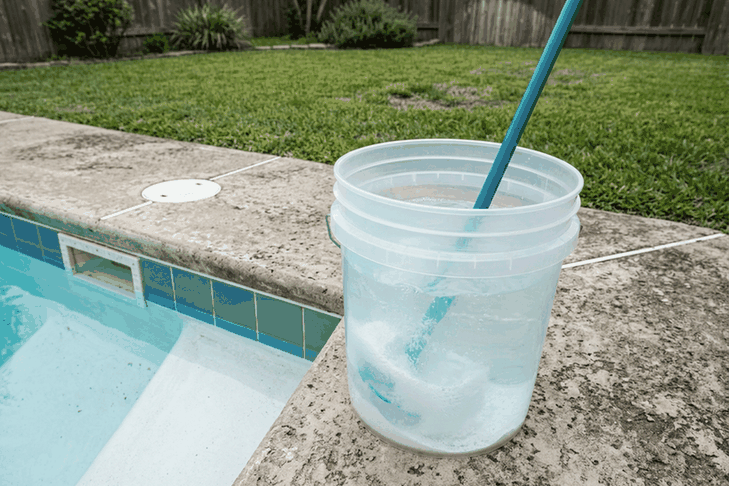
- With cal-hypo, if the label permits, mix it first in a bucket of pool water, then walk it slowly around the deep end. Never toss dry granules straight onto a vinyl liner.
- With liquid chlorine, pour it slowly at a return jet, where water pushes back into the pool.
- Give the pool another brush and leave the cover off overnight.
- Test free chlorine at bedtime and again when you get up. Any time it sinks far under the amount you added, bring it back with liquid chlorine.
- Let the filter keep going, which can take anywhere from a day up to a week. Clean the filter, or backwash it (run it in reverse to flush out dirt), once its pressure gauge reads 8 to 10 PSI above what it showed right after the last cleaning.
Knowing the Treatment Is Finished
The work is over once the water runs clear and your free chlorine loses no more than 1 ppm overnight. Test once the sun goes down, then again before it comes up. A larger drop means something is still in there, consuming your chlorine.
Swimming Again After a Green Pool
Do not let anyone back in the water until you can see the drain grate down at the deep end from the poolside. Free chlorine should sit at 1 to 4 ppm, or 2 ppm at minimum in a stabilized pool, with a pH reading of 7.2 to 7.8. These limits trace back to guidance from the CDC along with the Model Aquatic Health Code.
Common Questions
Is Algaecide Worth Adding as Well?
Algaecide can help, but put it in 24 hours after the shock, never alongside it.
Why Is the Water Still Green After Shocking, Even Though It Is Clear?
When water runs clear but keeps a green tint right after a shock, metal like copper or iron is normally to blame, not algae. Another shock only makes things worse, so a different fix is needed, which our guide to green pool water after shocking explains.
The Algae Has Gone but the Water Looks Cloudy. What Now?
Killed algae often leaves a haze behind, so keep the filter going. A clarifier will handle a light haze. With heavy cloud, a flocculant drops it to the floor overnight, and you will then need to vacuum it out while the filter valve points to waste. The clarifier and flocculant page lays out the differences.
Is yellow water the same problem?
Yellow points to mustard algae, which gets its own treatment. Head over to the mustard algae page for that.
What if the Water Is Still Green After a Week?
When a week of treatment plus a clean filter has not cleared the green or the cloud, bring a water sample to a pool store for a stabilizer and metals check, or have a pool service take a look.