
Troubleshooter › Algae
Mustard Algae
Mustard algae shows up as a yellow, dust-like film that could pass for dirt or sand on your pool floor or walls. It belongs to the green algae family, but it stands up to chlorine. Getting rid of it usually means a much stronger shock than usual, plenty of brushing, and cleaning anything the water has touched.
- Shock
- 3 lb per 10,000 gallons
- Wash
- Suits, toys, brush and vacuum head
- Usually gone in
- 3 to 5 days; some take a week
- Can you swim?
- Wait 8 hours after a shock, then retest
Not sure this is your water? Match your water by photo.
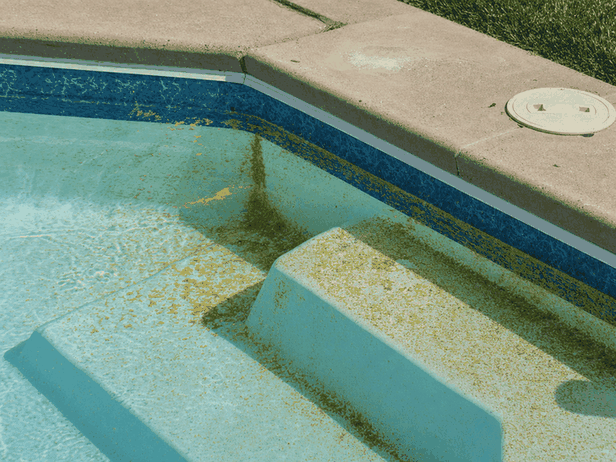
What It Looks Like
You will find mustard algae settled on the floor or clinging to the walls, where it looks a lot like dirt or sand. People often assume it is debris that blew into the pool.
It also comes off with very little effort when you brush, which makes it seem like no big deal. The trouble is that it bounces right back, so brushing alone will never clear it up.
Is It Really Mustard Algae?
Try a quick brush test. Wipe the yellow patch away, then check that spot again after a while. If it is mustard algae, the patch will usually show up again in the same place within 12 to 24 hours.
If the whole body of water has a yellow tint instead of patches on surfaces, metals may be to blame. It is worth testing for metals before you shock, since a shock in copper-heavy water can cause brown staining.
Before You Start
Your test kit gives chlorine as ppm (parts per million). That is just the unit for how much chlorine the water holds. A regular shock takes the water to roughly 10 ppm, which typically is not enough for mustard algae. You need to reach 30 ppm free chlorine.
Check your stabilizer level, also called CYA: anything above 80 ppm weakens chlorine and works against the treatment. For the same reason, skip stabilized chlorine, sold as dichlor or trichlor, while you shock, because it puts even more stabilizer into the water.
While chlorinating, keep the pH between 7.2 and 7.8.
Yellow Algae Pool Treatment, Step by Step
- Start by scrubbing every affected surface, walls, floor and all, with a stiff-bristle brush.
- If your setup allows it, vacuum the loosened algae on the "waste" setting. That sends it out of the pool instead of through the filter, where it could end up back in the water.
- Toss toys, floats, brushes, hoses and baskets into the pool so the potent chlorine can treat them as well. Algae sitting on any of them can restart the problem.
- Mustard algae needs far more shock than a routine dose, so use the troubleshooter on our home page to work out the shock or liquid chlorine amount for your pool size. If you use granular shock, dissolve it in a bucket of water first, then pour the bucket into the pool, and keep testing and adding until the water reads 30 ppm free chlorine.
- Run the pump 24 hours a day throughout the treatment.
- Brush the affected areas at least twice a day as long as the chlorine stays high.
- Test each morning and evening and keep chlorine near 30 ppm until it drops by 1 ppm or less overnight. Most pools need 3 to 5 days of this, and some take up to a week. If algae is still visible, shock again.
- Once the algae is gone, stop adding chlorine, and when it falls below 5 ppm, add an algaecide that kills all types of pool algae.
- Clean or backwash the filter when the treatment wraps up.
How to Tell the Algae Is Gone
Check chlorine levels at night and again first thing in the morning. If chlorine drops by 1 ppm or less overnight, the algae is gone. A bigger overnight drop means something is still using it up.
Cleaning Swimsuits and Equipment
Include pool equipment and swimsuits in your cleanup, since anything that spent time in the water can bring the algae back. Equipment that stayed out of the pool during treatment can take a soak in chlorinated water for at least 30 minutes. For swimsuits, wash with detergent, then dry them completely in the sun.
Frequently Asked Questions
Will mustard algae disappear on its own?
No, it won't go away by itself, and brushing only hides it for a while because it comes back quickly, so you need the 30 ppm chlorine treatment to get rid of it.
How can you stop mustard algae from returning?
A clean filter and good water movement matter a lot. Make sure your pool has adequate circulation and filtration.
Not quite your water?
Tap the photo that matches your water for the likely cause and the plan that goes with it.