
Troubleshooter › Cloudy water
Milky Pool Water
Most of the time, milky pool water comes down to pH or alkalinity that has climbed too high. When that happens, calcium falls out of the water as a fine white dust. The fix is to get pH and alkalinity back where they belong, then let the filter take the particles out.
- Likely cause
- Calcium or dead algae
- Calcium hardness range
- 200 to 400 ppm
- First fix
- Bring pH down, then filter
- Can you swim?
- Not until you can see the main drain. That is the grate at the deepest point, and free chlorine should read 1 to 4 ppm (parts per million).
Not sure this is your water? Match your water by photo.
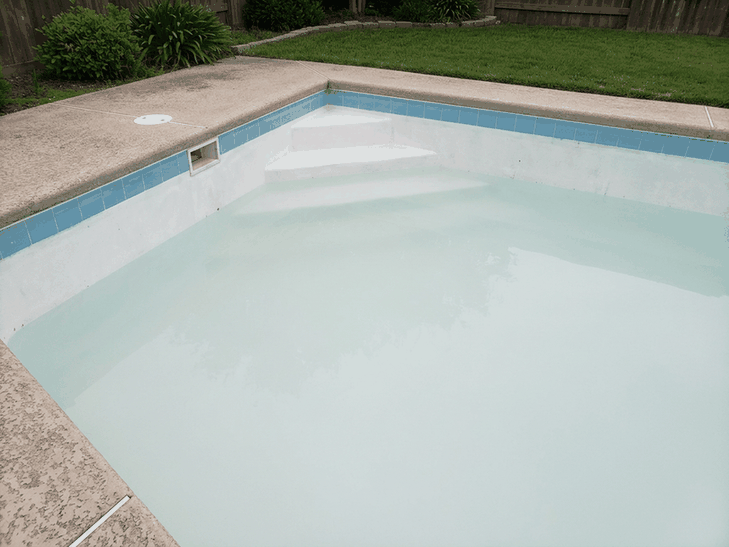
Why does pool water turn milky?
If your pH or total alkalinity is high, the calcium that was dissolved in the water turns into tiny white specks. Total alkalinity tells you how much the water pushes back against pH change. You will find it printed on most test strips and kits.
Once pH hits 8.0, calcium clouding is very likely. A high pH dulls your chlorine and builds scale on the pool surfaces and gear, so it is worth fixing even when the water still looks fine.
Alkalinity matters because it drives pH. Past 120 ppm, it pushes pH up and holds it there. So if you lower your pH and it keeps climbing back, alkalinity is often the reason.
How does calcium hardness affect milky water?
Calcium hardness is simply how much calcium is dissolved in your water, and too much of it can turn the water cloudy too. The target is 200 to 400 ppm. Water with a lot of calcium will go cloudy unless pH or alkalinity sits low enough to balance it.
Timing your chemicals matters too. Do not add calcium chloride within a few hours of treating with soda ash or baking soda, because mixing them turns the water cloudy.
These targets guide the advice on every page here:
| Reading | Aim for |
|---|---|
| Free chlorine | 1 ppm or higher |
| pH | between 7.2 and 7.8 |
| Total alkalinity | somewhere in 80 to 120 ppm |
| Calcium hardness | somewhere in 200 to 400 ppm |
The alkalinity range comes from Sensorex, and the chlorine target follows the CDC.
How to clear milky water
More chlorine will not clear clouding that comes from calcium. Balancing the water is what does it.
- Test pH, alkalinity, and calcium first, so you can spot which one has drifted.
- Start the pump so the water is circulating before you pour in any acid.
- Follow the product label when you dose the acid. Acid always goes into water, never the other way round.
- Wait at least 30 minutes after adding acid before swimming, and stay out if the water is still too cloudy to see the bottom clearly.
- After 3 to 4 hours, retest pH. Only add more acid if the reading is still over 7.8.
- Run the pump for at least 8 hours each day. If you have a sand filter, run it for 24 to 72 hours at a time.
When calcium hardness goes over 400 ppm, you have two routes. One is to drain part of the pool and refill it with softer water. The other is to use acid to pull pH and alkalinity down, so the water can carry the extra calcium without turning cloudy.
Should you use clarifier or flocculant?
Clarifier is a product that bunches small particles into bigger clumps the filter can grab. Give it 24 hours before you backwash. Still cloudy after 48 hours? Check the filter is clean before you run it longer.
Flocculant does a different job. It drops the particles to the bottom. The pump has to stay off for 8 to 12 hours at a minimum, usually overnight, while everything settles. Then vacuum the layer on the floor to waste rather than through the filter.
Is it safe to swim in milky water?
Public pool rules give a useful benchmark. The CDC Model Aquatic Health Code says the water must be clear enough to show the bottom of the pool. A public pool cannot open if you cannot see the main drain from the side. That is a good rule of thumb for a backyard pool as well.
Questions We Get Often
Will shock clear a cloudy pool?
Shock helps only when no chlorine registers on the test or tiny organisms have taken hold. If your test shows no chlorine at all, shock with 1 lb of cal-hypo per 10,000 gallons (see here), or about 0.6 gallon of 12.5% liquid chlorine per 10,000 gallons. The troubleshooter on our home page can work out the amount for your own pool. Keep pH at 7.2 to 7.8 while you chlorinate.
My chlorine reads fine, so why is the water still milky?
Then chlorine isn't the problem. High pH or alkalinity can make dissolved calcium turn into fine white particles, and high calcium hardness can also add to it. Test those two and your calcium hardness, and bring pH down if it is above 7.8.
How often should I test?
Test daily for the first three weeks after you fill the pool, and again each day whenever it goes hotter than 25°C.
Which works faster, clarifier or flocculant?
With flocculant, leave the pump off for at least 8 to 12 hours, usually overnight, then vacuum the settled particles out of the pool rather than through the filter. Clarifier can take a day or two, but the pump keeps running and there is nothing to vacuum.
Get the plan for your pool size
Tap the photo that matches your water and type your pool size: the troubleshooter works out the shock in pounds and the liquid chlorine in gallons.